Summary

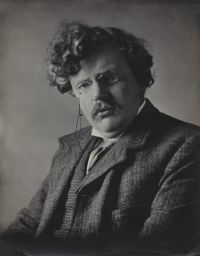
Portrait of Gilbert Keith Chesterton Gilbert Keith Chesterton Appreciations and Criticisms of the Works of Charles Dickens… (1911)

Chester, a cynic as he is, believes seriously in the beauty of being a gentleman; a real man of that type probably disbelieved in that as in everything else. Dickens was too bracing, one may say too bouncing himself to understand the psychology of fatigue in a protected and leisured class. He could understand a tyrant like Quilp, a tyrant who is on his throne because he has climbed up into it, like a monkey. He could not understand a tyrant who is on his throne because he is too weary to get out of it. The old aristocrats were in a dead way quite good-natured.
Source: Wikisource

Portrait of Gilbert Keith Chesterton Gilbert Keith Chesterton Appreciations and Criticisms of the Works of Charles Dickens… (1911)

Nevertheless both belonged more typically to the age out of which Dickens came -- the great sceptical and yet creative eighteenth century of Europe. Whether the mob rose on the right side or the wrong they both belonged to the time in which a mob could rise, in which a mob could conquer. No growth of intellectual science or of moral cowardice had made it impossible to fight in the streets, whether for the republic or for the Bible.
Source: Wikisource

Portrait of Gilbert Keith Chesterton Gilbert Keith Chesterton Appreciations and Criticisms of the Works of Charles Dickens… (1911)

A man who deals in harmonies, who only matches stars with angels or lambs with spring flowers, he indeed may be frivolous; for he is taking one mood at a time, and perhaps forgetting each mood as it passes. But a man who ventures to combine an angel and an octopus must have some serious view of the universe. The man who should write a dialogue between two early Christians might be a mere writer of dialogues. But a man who should write a dialogue between an early Christian and the Missing Link would have to be a philosopher.
Source: Wikisource

Get perspective with Kwize: daily news enlightened by great literature