Summary

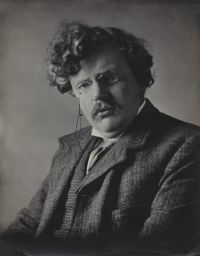
Portrait of Gilbert Keith Chesterton Gilbert Keith Chesterton Appreciations and Criticisms of the Works of Charles Dickens… (1911)

It may be admitted that Thackeray would not have allowed an absurd opinion to walk about the street without at least tying a man on to it for the sake of safety. But while this first truth may be evident, the second truth which is the complement of it may easily be forgotten. On the one hand there was no man who could so much enjoy mere intellectual satire apart from humanity as Dickens. On the other hand there was no man who, with another and more turbulent part of his nature, demanded humanity, and demanded its supremacy over intellect, more than Dickens.
Source: Wikisource

Portrait of Gilbert Keith Chesterton Gilbert Keith Chesterton Appreciations and Criticisms of the Works of Charles Dickens… (1911)

You may have the dullest possible intelligence and be a portrait painter; but a man must have a serious intellect in order to be a caricaturist. He has to select what thing he will caricature. True satire is always of this intellectual kind; true satire is always, so to speak, a variation or fantasia upon the air of pure logic. The satirist is the man who carries men's enthusiasm further than they carry it themselves.
Source: Wikisource

Portrait of Gilbert Keith Chesterton Gilbert Keith Chesterton Appreciations and Criticisms of the Works of Charles Dickens… (1911)

In this book Dickens has not allowed us to love the most absurd people seriously, and absurd people ought to be loved seriously. Pecksniff has to be amusing all the time; the instant he ceases to be laughable he becomes detestable. Pickwick can take his ease at his inn; he can be leisurely, he can be spacious; he can fall into moods of gravity and even of dulness; he is not bound to be always funny or to forfeit the reader's concern, for he is a good man, and therefore even his dulness is beautiful, just as is the dulness of the animal.
Source: Wikisource

Get perspective with Kwize: daily news enlightened by great literature