Summary

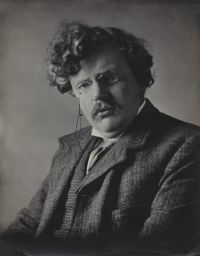
Portrait of Gilbert Keith Chesterton Gilbert Keith Chesterton Heretics — Chapter 6: Christmas and the Aesthetes (1905)

The object of philanthropy is to do good; the object of religion is to be good, if only for a moment, amid a crash of brass.
And the same antithesis exists about another modern religion--I mean the religion of Comte, generally known as Positivism, or the worship of humanity. Such men as Mr. Frederic Harrison, that brilliant and chivalrous philosopher, who still, by his mere personality, speaks for the creed, would tell us that he offers us the philosophy of Comte, but not all Comte's fantastic proposals for pontiffs and ceremonials, the new calendar, the new holidays and saints' days.
Source: Wikisource

Portrait of Gilbert Keith Chesterton Gilbert Keith Chesterton Heretics — Chapter 6: Christmas and the Aesthetes (1905)

Let no man deceive himself; if by vulgarity we mean coarseness of speech, rowdiness of behaviour, gossip, horseplay, and some heavy drinking, vulgarity there always was wherever there was joy, wherever there was faith in the gods. Wherever you have belief you will have hilarity, wherever you have hilarity you will have some dangers. And as creed and mythology produce this gross and vigorous life, so in its turn this gross and vigorous life will always produce creed and mythology.
Source: Wikisource

Portrait of Gilbert Keith Chesterton Gilbert Keith Chesterton Heretics — Chapter 6: Christmas and the Aesthetes (1905)

A man cannot pay that kind of reverence to truth solid as marble; they can only be reverent towards a beautiful lie. And the Salvation Army, though their voice has broken out in a mean environment and an ugly shape, are really the old voice of glad and angry faith, hot as the riots of Dionysus, wild as the gargoyles of Catholicism, not to be mistaken for a philosophy. Professor Huxley, in one of his clever phrases, called the Salvation Army "corybantic Christianity."
Source: Wikisource

Get perspective with Kwize: daily news enlightened by great literature