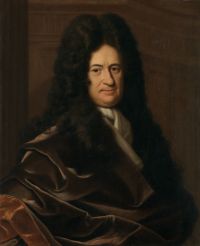
Gottfried Leibniz

Gottfried Leibniz

Summary

Portrait of Gottfried Leibniz Gottfried Leibniz A Philosopher's Creed

Spontaneity comes from one's ability, whereas freedom comes from knowledge. But given that we have a good opinion of something, we cannot help but desire it; likewise, we cannot help but do something, if we desire it and recognize the opportunity. Nothing is more strange than to mutate the idea of free will into the incredible, even absurd, ability to act for no reason whatsoever. The privilege of free will consists of standing at the crossroads of life and only doing what we desire; and we can only desire what we consider good.
Source: Wikisource

Portrait of Gottfried Leibniz Gottfried Leibniz A Philosopher's Creed

You asked me, "What was the reason for his damnation?" to which I replied, "The reason was the condition of the dying man, namely the burning hatred of God in which he died." For since the soul is not open to new, external sensations after death (when the body is returned) the soul sticks to its last thoughts. These do not change, but are intensified in death. But hating God, Who is the happiest being, leads to the greatest pain, since hatred means to suffer pain because of the hated one's happiness, just as love means to rejoice in the beloved's happiness.
Source: Wikisource

Portrait of Gottfried Leibniz Gottfried Leibniz A Philosopher's Creed

For what does it matter if we reconcile sins with divine goodness, if sins cannot be reconciled with our freedom? What good does it do to acquit God, if the guilty are acquitted with Him? How do we profit, if in releasing the divine will, we render every will powerless? For I ask you, what is human freedom, if everything we are is the result of external things, if all our desires are determined by them, if a predestined logical sequence rules over our thoughts, the mere by-product of interacting atoms?
Source: Wikisource

Get perspective with Kwize: daily news enlightened by great literature