Summary

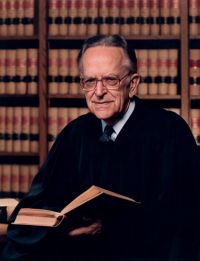
Portrait of Harry Blackmun Harry Blackmun Taylor v. United States — Opinion of the Court

But, even assuming that Congress intended to restrict the predicate offense to some especially dangerous subclass of burglaries, restricting it to common-law burglary would not be a rational way of doing so. The common-law definition does not require that the offender be armed or that the dwelling be occupied at the time of the crime. An armed burglary of an occupied commercial building, in the daytime, would seem to pose a far greater risk of harm to persons than an unarmed nocturnal breaking and entering of an unoccupied house.
Source: Wikisource

Portrait of Harry Blackmun Harry Blackmun Taylor v. United States — Opinion of the Court

Almost all States include a breaking and entering of a dwelling at night, with intent to commit a felony, among their definitions of burglary. Whatever else the Members of Congress might have been thinking of, they presumably had in mind at least the "classic" common-law definition when they considered the inclusion of burglary as a predicate offense.
The problem with this view is that the contemporary understanding of "burglary" has diverged a long way from its common-law roots. Only a few States retain the common law definition, or something closely resembling it.
Source: Wikisource

Portrait of Harry Blackmun Harry Blackmun Taylor v. United States — Opinion of the Court

Thus, a person imprudent enough to shoplift or steal from an automobile in California would be found, under the Ninth Circuit's view, to have committed a burglary constituting a "violent felony" for enhancement purposes—yet a person who did so in Michigan might not. Without a clear indication that with the 1986 amendment Congress intended to abandon its general approach of using uniform categorical definitions to identify predicate offenses, we do not interpret Congress' omission of a definition of "burglary" in a way that leads to odd results of this kind.
Source: Wikisource

Get perspective with Kwize: daily news enlightened by great literature