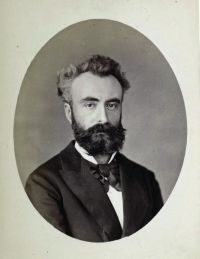
Henri Émile Sauvage

Henri Émile Sauvage

Summary

Portrait of Henri Émile Sauvage Henri Émile Sauvage,  Popular Science Monthly (1877)

“ Accustomed to keep near the shore, amid the rocks and in shallow waters, swimming swiftly and ever moving, they are constantly reflecting the splendid colors with which they are decorated. Rose-color, purple, azure, velvety-black, milk-white, are gorgeously displayed on their surface, in the form of bands, streaks, curved lines running in various directions, rings, ocellated spots. These colors stand out boldly on the surface of the body, which furnishes a background of the richest nacreous tints of gold and silver, or of polished steel. ”
Source: Wikisource

Portrait of Henri Émile Sauvage Henri Émile Sauvage,  Popular Science Monthly (1877)

“ When the archer espies an insect which it wishes to seize, but which is flying too high above the surface to be captured by leaping out of the water, it approaches as near as possible to its prey, then it fills its mouth-cavity with water, shuts its gill-openings, suddenly compresses its little slit of a mouth, and, ejecting rapidly the water through the very narrow tube which forms its snout, squirts it often to the distance of two metres, and that with such force that the insect is stunned and falls into the sea. ”
Source: Wikisource

Portrait of Henri Émile Sauvage Henri Émile Sauvage,  Popular Science Monthly (1876)

“ The animal doubles itself up in its envelope, the tail being brought up in front of the head; the mouth is free, and through it passes the air needed for respiration, which, of course, is exclusively pulmonary, owing to the conditions in which the animal lives. In fact, the protopterus is able to respire in two ways, viz., either directly in the atmosphere, or indirectly by separating dissolved oxygen from water by means of its gills. ”
Source: Wikisource

Get perspective with Kwize: daily news enlightened by great literature