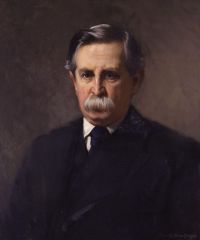
Henry Austin Dobson

Henry Austin Dobson

Summary

Portrait of Henry Austin Dobson Henry Austin Dobson 1911 Encyclopædia Britannica (1911)

As Sir Walter Scott has said, no one before had dived so deeply into the human heart. No one, moreover, had brought to the study of feminine character so much prolonged research, so much patience of observation, so much interested and indulgent apprehension, as this twittering little printer of Salisbury Court. That he did not more materially control the course of fiction in his own country was probably owing to the new direction which was given to that fiction by Fielding and Smollett, whose method, roughly speaking, was synthetic rather than analytic.
Source: Wikisource

Portrait of Henry Austin Dobson Henry Austin Dobson 1911 Encyclopædia Britannica (1911)

In 1768 died Philip Stanhope, the child of so many hopes. The constant care bestowed by his father on his education resulted in an honourable but not particularly distinguished career for young Stanhope. His death was an overwhelming grief to Chesterfield, and the discovery that he had long been married to a lady of humble origin must have been galling in the extreme to his father after his careful instruction in worldly wisdom.
Source: Wikisource

Portrait of Henry Austin Dobson Henry Austin Dobson 1911 Encyclopædia Britannica (1911)

For the exceptional success of Pamela there was the obvious excuse of novelty. People were tired of the old “mouthy” romances about impossible people doing impossible things. Here was a real-life story, which might happen to any one—a story which aroused curiosity and arrested attention—which was not exclusively about “high life,” and which had, in addition, a moral purpose, since it was avowedly “ published in order to cultivate the principles of virtue and religion in the minds of the youth of both sexes.”
Source: Wikisource

Get perspective with Kwize: daily news enlightened by great literature