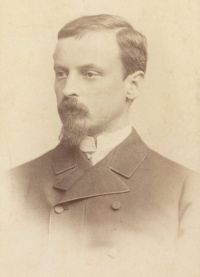
Henryk Sienkiewicz

Henryk Sienkiewicz

Summary

Portrait of Henryk Sienkiewicz Henryk Sienkiewicz On the Bright Shore (1898)

As the boat, urged by a strong breeze, approached the harbor, every one of those lights changed, as it were, into a pillar of fire, which quivered on the moving water near the shore. The sight of these gleams sobered Svirski.
"The city!—and life!" thought he.
And at once his former plans began to fall apart like dream-visions born of night and emptiness. That which a moment earlier he thought justifiable, necessary, and easy of accomplishment, seemed a whim devoid of the essence of reality, and in part dishonest. "With life, whatever it be, one must reckon.
Source: Wikisource

Portrait of Henryk Sienkiewicz Henryk Sienkiewicz On the Bright Shore (1898)

For if all life is a falsehood, what is to be done in face of that fact? Return to nature? Begin some sort of life half savage, half peasant? Break with people and become a reformer right away? Svirski felt too old for this, and too sceptical. For such a course one needs to have the dogmatism of Kresovich, and to feel evil as a spur to battle and reform, not as a mere impression which may grow faint to-morrow! But another thought came to Svirski's mind as a recompense. The man who does not feel in himself power to reform the world, may flee from it, for a time, at least, and draw breath.
Source: Wikisource

Portrait of Henryk Sienkiewicz Henryk Sienkiewicz On the Bright Shore (1898)

Svirski had marvelled always that the Renaissance had not recreated the symbol of death. Indeed, if Death had not always been silent, and had desired to complain, it would have said, „Why do people depict me as a skeleton? A skeleton is just what I have no wish to be, and will not be!" In Svirski's picture the genius of Sleep was delivering, mildly and quietly, the body of a maiden to the genius of Death, who, bending down, extinguished in silence the flame of a lamp burning at her head.
Source: Wikisource

Get perspective with Kwize: daily news enlightened by great literature