Summary

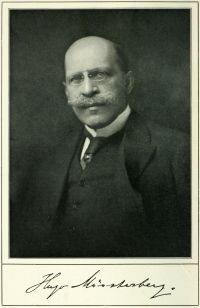
Portrait of Hugo Münsterberg Hugo Münsterberg The Photoplay: A Psychological Study

The spectator may not and ought not to be aware that the lines of the background, the hangings of the room, the curves of the furniture, the branches of the trees, the forms of the mountains, help to point toward the figure of the woman who is to hold his mind. The shading of the lights, the patches of dark shadows, the vagueness of some parts, the sharp outlines of others, the quietness of some parts of the picture as against the vehement movement of others all play on the keyboard of our mind and secure the desired effect on our involuntary attention.
Source: Gutenberg

Portrait of Hugo Münsterberg Hugo Münsterberg The Photoplay: A Psychological Study

Life pushes us forward. Yet sometimes a touch of nature comes to us; we are stirred by a thrill of life which awakens plenty of impulses but which offers satisfaction to all these impulses in itself. It does not lead beyond itself but contains in its own midst everything which answers the questions, which brings the desires to rest.
Wherever we meet such an offering of nature, we call it beautiful. We speak of the beautiful landscape, of the beautiful face. And wherever we meet it in life, we speak of love, of friendship, of peace, of harmony.
Source: Gutenberg

Portrait of Hugo Münsterberg Hugo Münsterberg The Photoplay: A Psychological Study

The word harmony may even cover both nature and life. Wherever it happens that every line and every curve and every color and every movement in the landscape is so harmonious with all the others that every suggestion which one stirs up is satisfied by another, there it is perfect and we are completely happy in it. In the life relations of love and friendship and peace, there is again this complete harmony of thought and feeling and will, in which every desire is satisfied. If our own mind is in such flawless harmony, we feel the true happiness which crowns our life.
Source: Gutenberg

Get perspective with Kwize: daily news enlightened by great literature