Summary

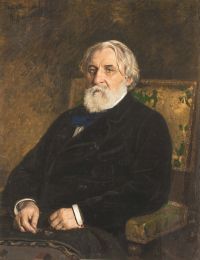
Portrait of Ivan Sergeevich Turgenev Ivan Sergeevich Turgenev A Desperate Character and Other Stories

Despise her, Ivan Afanasiitch; you simply break it off. Listen to me, or else I’ll fetch a wise woman; she’ll break the spell in no time. You’ll laugh at it yourself, later on; you’ll say to me, “Onisim, why, it’s marvellous how such things happen sometimes!” You just consider yourself: girls like her, they’re like dogs ... you’ve only to whistle to them....’
Like one frantic, Pyetushkov jumped up from the sofa ... but, to the amazement of Onisim, who was already lifting both hands to the level of his cheeks, he sat down again, as though some one had cut away his legs from under him....
Source: Gutenberg

Portrait of Ivan Sergeevich Turgenev Ivan Sergeevich Turgenev A Desperate Character and Other Stories

Pyetushkov is the work of a young man of twenty-nine, and its lively, unstrained realism is so bold, intimate, and delicate as to contradict the flattering compliment that the French have paid to one another—that Turgenev had need to dress his art by the aid of French mirrors.
Although Pyetushkov shows us, by a certain open naïveté of style, that a youthful hand is at work, it is the hand of a young master, carrying out the realism of the ‘forties’—that of Gogol, Balzac, and Dickens—straightway, with finer point, to find a perfect equilibrium free from any bias or caricature.
Source: Gutenberg

Portrait of Ivan Sergeevich Turgenev Ivan Sergeevich Turgenev A Desperate Character and Other Stories

Vassilissa ran into the house. Pyetushkov returned home. But from that day he began going often to the baker’s shop, and his visits were not for nothing. Ivan Afanasiitch’s hopes, to use the lofty phraseology suitable, were crowned with success. Usually, the attainment of the goal has a cooling effect on people, but Pyetushkov, on the contrary, grew every day more and more ardent. Love is a thing of accident, it exists in itself, like art, and, like nature, needs no reasons to justify it, as some clever man has said who never loved, himself, but made excellent observations upon love.
Source: Gutenberg

Get perspective with Kwize: daily news enlightened by great literature