Summary

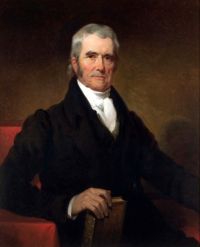
Portrait of John Marshall John Marshall Opinion of the Supreme Court of the United States…

They are in direct hostility with treaties, repeated in a succession of years, which mark out the boundary that separates the Cherokee country from Georgia; guaranty to them all the land within their boundary; solemnly pledge the faith of the United States to restrain their citizens from trespassing on it; and recognize the pre-existing power of the nation to govern itself.
Source: Gutenberg

Portrait of John Marshall John Marshall Opinion of the Supreme Court of the United States…

The United States succeeded to all the claims of Great Britain, both territorial and political, but no attempt, so far as is known, has been made to enlarge them. So far as they existed merely in theory, or were in their nature only exclusive of the claims of other European nations, they still retain their original character, and remain dormant. So far as they have been practically exerted, they exist in fact, are understood by both parties, are asserted by the one, and admitted by the other.
Source: Gutenberg

Portrait of John Marshall John Marshall Opinion of the Supreme Court of the United States…

The Cherokee nation, then, is a distinct community, occupying its own territory, with boundaries accurately described, in which the laws of Georgia can have no force, and which the citizens of Georgia have no right to enter, but with the assent of the Cherokees themselves, or in conformity with treaties, and with the acts of Congress. The whole intercourse between the United States and this nation, is, by our constitution and laws, vested in the Government of the United States.
Source: Gutenberg

Get perspective with Kwize: daily news enlightened by great literature