Summary

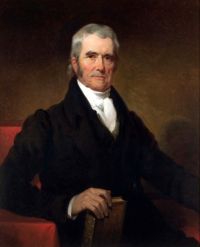
Portrait of John Marshall John Marshall United States v. Clarke (33 U.S. 436…

He who would controvert a grant executed by the lawful authority, with all the solemnities required by law, takes upon himself the burden of showing that the officer has transcended the powers conferred upon him, or that the transaction is tainted with fraud.
This the counsel for the United States undertakes to do. He insists that governor Coppinger has transcended his powers in making the title now under consideration for a larger quantity of land than he was empowered to grant, and on a consideration not warranted by law.
Source: Wikisource

Portrait of John Marshall John Marshall United States v. Clarke (33 U.S. 436…

While Florida remained a province of Spain, the right of his catholic majesty, acting in person or by his officers, to distribute lands according to his pleasure, was unquestioned. That he was in the constant exercise of this power, was well known. If the United States were nor content to receive the territory, charged with titles thus created, they ought to have made, and they would have made, such exceptions as they deemed necessary. They have made these exceptions.
Source: Wikisource

Portrait of John Marshall John Marshall United States v. Clarke (33 U.S. 436…

The regulations of governor Quesada, which have been cited, and in which he appears to have deviated, in some respects, from the law to which he refers, apply to the general objects of cultivation, population and settlement, and ought to conform to the laws which had been framed for those subjects. He seems to grant a general privilege to every individual to acquire lands at will. He retains to himself no discretion, exercises no judgment in the case.
Source: Wikisource

Get perspective with Kwize: daily news enlightened by great literature