Summary

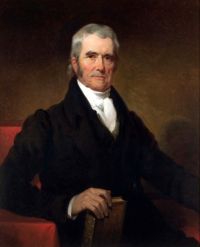
Portrait of John Marshall John Marshall United States v. Percheman — Opinion of the Court

Both have been invented by mankind for purposes of mutual defence and common justice, but the prevading spirit of the one is preventive, of the other vindicatory. How absurd would it be, then, to apply the maxims of the one government to the acts of the other. As well might we judge the life of Pythagoras by the law of the New Testament, or the philosophy of Zoroaster by that of Newton, as subject the administration of a Spanish governor to the test of magna charta, the bill of rights, the habeas corpus act, or the principles of American constitutional law.
Source: Wikisource

Portrait of John Marshall John Marshall United States v. Percheman — Opinion of the Court

Neither party could so understand the cession; neither party could consider itself as attempting a wrong to individuals, condemned by the practice of the whole civilized world. The cession of a territory, by its name, from one sovereign to another, conveying the compound idea of surrendering at the same time the lands and the people who inhabit them, would be necessarily understood to pass the sovereignty only, and not to interfere with private property.
Source: Wikisource

Portrait of John Marshall John Marshall United States v. Percheman — Opinion of the Court

How is it possible to reconcile limitations of power with the fundamental maxim, 'the will of the prince has the force of a law?' Portions of the royal authority, as arbitrary as that of the king himself, were intrusted to the several governors of provinces, each of whom, within the limits of his own government, was the image of his sovereign, and, in practice, at least, and in popular opinion also, absolute.
Source: Wikisource

Get perspective with Kwize: daily news enlightened by great literature