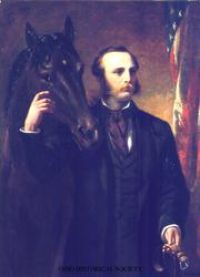
John Solomon Rarey

John Solomon Rarey

Summary

Portrait of John Solomon Rarey John Solomon Rarey The Modern Art of Taming Wild Horses (1858)

The horse, according to the best accounts we can gather, has been the constant servant of man for nearly four thousand years, ever rewarding him with his labour and adding to his comfort in proportion to his skill and manner of using him ; but being to those who govern him by brute force, and know nothing of the beauty and delight to be gained from the cultivation of his finer nature, a fretful, vicious, and often dangerous servant; whilst to the Arab, whose horse is the pride of his life, and who governs him by the law of kindness, we find him to be quite a different animal.
Source: Wikisource

Portrait of John Solomon Rarey John Solomon Rarey The Modern Art of Taming Wild Horses (1858)

When we remember that we are dealing with dumb brutes, and reflect how difficult it must be for them to understand our motions, signs, and language, we should never get out of patience with them because they don't understand us, or wonder at their doing things wrong. With all our intellect, if we were placed in the horse's situation it would be difficult for us to understand the driving of some foreigner, of foreign ways and foreign language.
Source: Wikisource

Portrait of John Solomon Rarey John Solomon Rarey The Modern Art of Taming Wild Horses (1858)

It is a great disadvantage in training a horse to have any one in the stable with you; you should be entirely alone, so as to have nothing but yourself to attract his attention. If he is wild, you will soon see him on the opposite side of the stable from you; and now is the time to use a little judgment. I should not want, for myself, more than half or three quarters of an hour to handle any kind of a colt, and have him running about in the stable after me
Source: Wikisource

Get perspective with Kwize: daily news enlightened by great literature