Summary

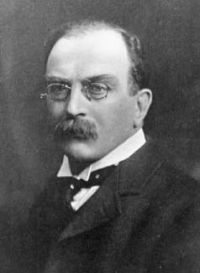
Portrait of Joseph Larmor Joseph Larmor On the ascertained Absence of Effects of Motion through the Aether… (1904)

If each pole or electron is connected with a molecule possessing extraneous mass, and it may be having an extraneous field of gravitational and other force of its own, and thereby interacting with other molecules, we shall want to know the forces exerted on that molecule by the surrounding æther, in order to form its own equations of motion, which must be combined with those of the æther-field around it in order to constitute a complete system.
Source: Wikisource

Portrait of Joseph Larmor Joseph Larmor On the ascertained Absence of Effects of Motion through the Aether… (1904)

As electrons are already held to be a reality on various grounds, theoretical and experimental, it would appear therefore that there is much to be said for a benevolent attitude to the proposition that all the interactions of matter, so far as the laws of physics and chemistry extend, are to be described as phenomena occurring in and through the aether, and thus differentiated from the more recondite world of vital growth and change which they make manifest to our senses.
Source: Wikisource

Portrait of Joseph Larmor Joseph Larmor On the ascertained Absence of Effects of Motion through the Aether… (1904)

But if such other forces are molecularly insignificant, or better, if the electron is a mere passive pole — nucleus of beknottedness in some way — in the æther, conditioned and controlled entirely by the æther around it, just as a vortex ring is conditioned by the fluid in which it subsists and is also carried along thereby, then, as in the familiar hydrodynamics of vortices, the motion of the æther determines the motion of the entirely passive electrons, and the idea of force acting between them and the æther is dispensed with.
Source: Wikisource

Get perspective with Kwize: daily news enlightened by great literature