Summary

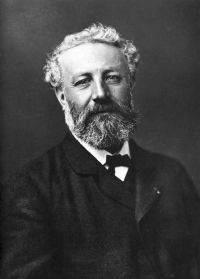
Portrait of Jules Verne Jules Verne A Journey into the Interior of the Earth (1877)

And there we were alone, in the bowels of the earth, at the mercy of its wild inhabitants!
My uncle was gazing with intense and eager interest.
"Come on!" said he, seizing my arm. "Forward! forward!"
"No, I will not!" I cried. "We have no firearms. What could we do in the midst of a herd of these four-footed giants? Come away, uncle—come! No human being may with safety dare the anger of these monstrous beasts."
"No human creature?" replied my uncle in a lower voice. "You are wrong, Axel. Look, look down there! I fancy I see a living creature similar to ourselves: it is a man!"
Source: Gutenberg

Portrait of Jules Verne Jules Verne A Journey into the Interior of the Earth (1877)

I asked uneasily.
"Look!" said my uncle.
I looked down upon the plain. An immense column of pulverized pumice, sand and dust was rising with a whirling circular motion like a waterspout; the wind was lashing it on to that side of Snæfell where we were holding on; this dense veil, hung across the sun, threw a deep shadow over the mountain. If that huge revolving pillar sloped down, it would involve us in its whirling eddies. This phenomenon, which is not unfrequent when the wind blows from the glaciers, is called in Icelandic 'mistour.'
"Hastigt! hastigt!" cried our guide.
Source: Gutenberg

Portrait of Jules Verne Jules Verne A Journey into the Interior of the Earth (1877)

Had all those creatures slided through a great fissure in the crust of the earth, down to the shores of the Liedenbrock sea, when they were dead and turning to dust, or had they lived and grown and died here in this subterranean world under a false sky, just like inhabitants of the upper earth? Until the present time we had seen alive only marine monsters and fishes. Might not some living man, some native of the abyss, be yet a wanderer below on this desert strand?
Source: Gutenberg

Get perspective with Kwize: daily news enlightened by great literature