Summary

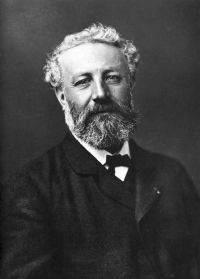
Portrait of Jules Verne Jules Verne Hector Servadac (Frewer translation… (1906)

This would leave 81,000,000 leagues more to be traversed before reaching the aphelion of the 15th of January, after which it would begin once more to approach the sun.
But meanwhile, a marvellous world, never before so close within the range of human vision, was revealing itself. No wonder that Palmyrin Rosette cared so little to quit his observatory; for throughout those calm, clear Gallian nights, when the book of the firmament lay open before him, he could revel in a spectacle which no previous astronomer had ever been permitted to enjoy.
Source: Wikisource

Portrait of Jules Verne Jules Verne Hector Servadac (Frewer translation… (1906)

On the 1st of September the distance between Gallia and Jupiter was precisely the same as the mean distance between the earth and the sun; on the 16th, the distance was further reduced to 26,000,000 leagues. The planet began to assume enormous dimensions, and it almost seemed as if the comet had already been deflected from its elliptical orbit, and was rushing on in a straight line towards the overwhelming luminary.
The more they contemplated the character of this gigantic planet, the more they became impressed with the likelihood of a serious perturbation in their own course.
Source: Wikisource

Portrait of Jules Verne Jules Verne Hector Servadac (Frewer translation… (1906)

The interval between the comet and Jupiter was, by the 1st of October, reduced to 43,000,000 miles—about twice the distance of the moon from the earth. Now, if Jupiter were, with regard to the earth, to change places with the moon, it is the indisputable attestation of science that its disc would be full thirty-four times larger than the moon's; it is consequently easy to imagine what was the wondrous brilliancy of Jupiter when surveyed in the same proximity.
Source: Wikisource

Get perspective with Kwize: daily news enlightened by great literature