Summary

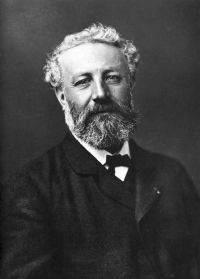
Portrait of Jules Verne Jules Verne Hector Servadac (Frewer translation… (1906)

It is as hard to find rhymes as to rally fugitives in a battle. But, by all the powers! it shan't be said that a French officer cannot cope with a piece of poetry. One battalion has shown fight—now for the rest!”
Perseverance had its reward. Presently two lines, one red, the other blue, appeared upon the paper, and the captain murmured—
“Words, mere words, cannot avail,
Telling true heart's tender tale.”
“What on earth ails my master?” muttered Ben Zoof, “for the last hour he has been as fidgety as a bird returning after its winter migration.”
Source: Wikisource

Portrait of Jules Verne Jules Verne Hector Servadac (Frewer translation… (1906)

The illustrious astronomer, however, based his estimate upon two conditions that are only fulfilled with the greatest uncertainty; in the first place, that at perihelion the comet should be nearer the sun than the earth is; and in the next, that the diameter of the comet should be equal to one-fourth of that of the earth. On the other hand, he only reckoned for the earth coming in contact with the actual nucleus, whilst if the whole extent of the nebulosity were to be taken into account, the chances of collision would be increased tenfold.
Source: Wikisource

Portrait of Jules Verne Jules Verne Hector Servadac (Frewer translation… (1906)

Modern science has, with more than sufficient justice, entirely repudiated the accuracy of these statements; but the indisputable testimony of recent observation all goes to establish the certainty of the existence of comets with a solid nucleus. The comets of 1774 and of 1828 are known to have caused the occupation of stars of the eighth magnitude; it is admitted on all hands that the comets of 1402, 1532, and 1744 were solid masses; whilst, as for the comet of 1843, the fact is patent to the world that the body could be seen close to the sun, in broad daylight, by the naked eye.
Source: Wikisource

Get perspective with Kwize: daily news enlightened by great literature