Summary

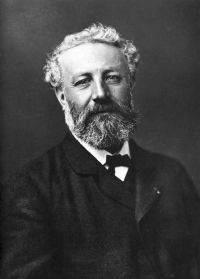
Portrait of Jules Verne Jules Verne The Voyages and Adventures of Captain Hatteras…

But, Doctor, will you tell me, once for all, what there is so remarkable about the Pole?”
“It is this, Johnson, that it is the only motionless part of the globe, while all the rest is turning with extreme rapidity.”
“But I don't see that we are more motionless here than at Liverpool.”
“No more than you perceive the motion at Liverpool; and that is because in both cases you participate in the movement or the repose. But the fact is no less certain. The earth rotates in twenty-four hours, and this motion is on an axis with its extremities at the two poles.
Source: Wikisource

Portrait of Jules Verne Jules Verne The Voyages and Adventures of Captain Hatteras…

Now, if it had been so, since the earth is flattened more than five leagues at the pole, the seas, carried to the equator by centrifugal force, would have covered mountains twice as high as the Himalayas; all the countries near the polar circle, Sweden, Norway, Russia, Siberia, Greenland, and New Britain, would have been buried in five leagues of water, while the regions at the equator, having become the pole, would have formed plateaus fifteen leagues high!
Source: Wikisource

Portrait of Jules Verne Jules Verne The Voyages and Adventures of Captain Hatteras…

One can't have a moment's peace in this world.”
“You are right, Bell,” answered Johnson; “and will you tell us, Doctor, how fast this motion is?”
“It is very fast,” answered the doctor; “the earth moves around the sun seventy-six times faster than a twenty-four-pound cannon-ball flies, which goes one hundred and ninety-five fathoms a second. It moves, then, seven leagues and six tenths per second; you see it is very different from the diurnal movement of the equator.”
Source: Wikisource

Get perspective with Kwize: daily news enlightened by great literature