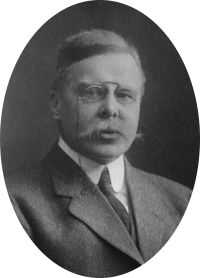
Kuno Francke

Kuno Francke

Summary

Portrait of Kuno Francke Kuno Francke The Harvard Classics Vol. 51 (1914)

Faust's wager with the devil is nothing but an act of temporary despair, and the very fact that he does not hope anything from it shows that he will win it. He knows that sensual enjoyment will never give him satisfaction; he knows that, as long as he gives himself up to self-gratification, there will never be a moment to which he would say: "Abide, thou art so fair!" From the outset we feel that by living up to the very terms of the compact, Faust will rise superior to it; that by rushing into the whirlpool of earthly experience and passion his being will be heightened and expanded.
Source: Wikisource

Portrait of Kuno Francke Kuno Francke The Harvard Classics Vol. 51 (1914)

The eighteenth century is the age of Rationalism and of Romanticism. The eighteenth century glorifies human reason and human feeling. The rights of man and the dignity of man are its principal watchwords. Such an age was bound to see in Faust a representative of true humanity, a champion of freedom, nature, truth. Such an age was bound to see in Faust a symbol of human striving for completeness of life.
Source: Wikisource

Portrait of Kuno Francke Kuno Francke The Harvard Classics Vol. 51 (1914)

But it is the fourth devil to whom Satan gives the prize. He has not done anything as yet. He has only a plan, but a plan which, if carried out, would put the deeds of all the other devils into the shade—the plan "to snatch from God his favorite." This favorite of God is Faust, "a solitary, brooding youth, renouncing all passion except the passion for truth, entirely living in truth, entirely absorbed in it." To snatch him from God—that would be a victory over which the whole realm of night would rejoice. Satan is enchanted; the war against truth is his element.
Source: Wikisource

Get perspective with Kwize: daily news enlightened by great literature