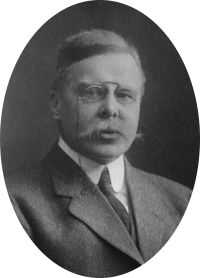
Kuno Francke

Biographical details

Portrait of Kuno Francke Kuno Francke The Harvard Classics Vol. 51 (1914)

Faust's wager with the devil is nothing but an act of temporary despair, and the very fact that he does not hope anything from it shows that he will win it. He knows that sensual enjoyment will never give him satisfaction; he knows that, as long as he gives himself up to self-gratification, there will never be a moment to which he would say: "Abide, thou art so fair!" From the outset we feel that by living up to the very terms of the compact, Faust will rise superior to it; that by rushing into the whirlpool of earthly experience and passion his being will be heightened and expanded.
Source: Wikisource

Portrait of Kuno Francke Kuno Francke ../../ (1913)

Then it was that men felt as if suddenly freed from the force and pressure of a thousand years; the artists, most of all, again breathed freely as the nightmare of Christianity seemed to spin whirling from their breasts, and they threw themselves with enthusiasm into the sea of Greek joyousness from whose foam rose to them goddesses of beauty. Painters once more limned the ambrosial joys of Olympus; sculptors carved, with the joy of yore, old heroes from the marble; poets again sang the house of Atreus and Laius; and so the age of new classic poetry began.
Source: Wikisource

Portrait of Kuno Francke Kuno Francke The German Classics of the Nineteenth and Twentieth Centuries (1913)

For I wedded the waterman with all his black, black slime.
My children they play in the lake with fishes fleet,
They have fins on their hands and fins on their feet,
Their little pearly frocks no sunlight ever dries,
Not death nor yet a dream can close my children's eyes—
Dear mother, oh I beg of thee,
Lovingly, longingly,
Wilt thou and all thy servants pray
For my green-haired water-sprites alway,
Will ye pray to the saints and to our Lady kind,
By every church and every cross that on the fields ye find!
Source: Wikisource

Get perspective with Kwize: daily news enlightened by great literature