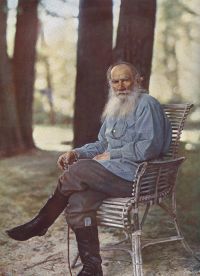
Leo Tolstoy

Leo Tolstoy

Summary

Portrait of Leo Tolstoy Leo Tolstoy Demands of Love and Reason (1902)

Lice, black bread, and want seem so terrible. But the bottom of the pit of want is not so deep after all, and we are often like the boy who clung by his hands, in terror, all night, to the edge of the well into which he had stumbled fearing the depth and the water he supposed to be there, while a foot below him was the dry bottom.
Yet we must not trust to that bottom; we must go forward prepared to die. Only that love is true love, which knows no limit to sacrifice—even unto death.
Source: Wikisource

Portrait of Leo Tolstoy Leo Tolstoy Demands of Love and Reason (1902)

Dreadful and difficult as is the position of a man living the Christian life, amidst the life of violence, he has no path but that of struggle and sacrifice—sacrifice without end.
One must realise the gulf that separates the verminous, famished millions from the over-fed, over-dressed rich; and to fill up this gulf we need sacrifices, and not the hypocrisy with which we now try to hide from ourselves the depth of the gulf.
A man may lack the strength to throw himself into the gulf—but it cannot be escaped by anyone who seeks after life.
Source: Wikisource

Portrait of Leo Tolstoy Leo Tolstoy Demands of Love and Reason (1902)

Even in the case I have imagined; not to admit a sick man to my hut and my bed, and to refuse the six shillings because I can, by force, retain them, is also to make use of compulsion. Therefore, in our society the struggle against force does not, for him who would live in brotherhood, eliminate the necessity of yielding up his life, of being eaten by lice, and of dying, whilst at the same time, always striving against violence, preaching non-resistance, exposing violence, and above all giving an example of non-resistance and of self-sacrifice.
Source: Wikisource

Get perspective with Kwize: daily news enlightened by great literature