Summary

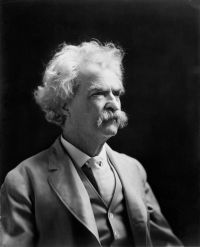
Portrait of Mark Twain Mark Twain A Tramp Abroad — Volume 02

In Germany they always hear one thing at an opera which has never yet been heard in America, perhaps—I mean the closing strain of a fine solo or duet. We always smash into it with an earthquake of applause. The result is that we rob ourselves of the sweetest part of the treat; we get the whiskey, but we don't get the sugar in the bottom of the glass.
Our way of scattering applause along through an act seems to me to be better than the Mannheim way of saving it all up till the act is ended. I do not see how an actor can forget himself and portray hot passion before a cold still audience.
Source: Gutenberg

Portrait of Mark Twain Mark Twain A Tramp Abroad — Volume 02

To my untutored ear that was music—almost divine music. While my seared soul was steeped in the healing balm of those gracious sounds, it seemed to me that I could almost resuffer the torments which had gone before, in order to be so healed again. There is where the deep ingenuity of the operatic idea is betrayed. It deals so largely in pain that its scattered delights are prodigiously augmented by the contrasts. A pretty air in an opera is prettier there than it could be anywhere else, I suppose, just as an honest man in politics shines more than he would elsewhere.
Source: Gutenberg

Portrait of Mark Twain Mark Twain A Tramp Abroad — Volume 02

Their language is full of endearing diminutives; nothing that they love escapes the application of a petting diminutive—neither the house, nor the dog, nor the horse, nor the grandmother, nor any other creature, animate or inanimate.
In the theaters at Hanover, Hamburg, and Mannheim, they had a wise custom. The moment the curtain went up, the light in the body of the house went down. The audience sat in the cool gloom of a deep twilight, which greatly enhanced the glowing splendors of the stage. It saved gas, too, and people were not sweated to death.
Source: Gutenberg

Get perspective with Kwize: daily news enlightened by great literature