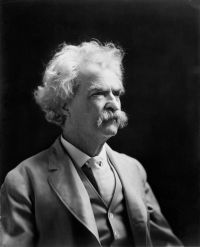
Mark Twain

Mark Twain

Summary

Portrait of Mark Twain Mark Twain The Gilded Age (1874)

Philip Sterling used to say that if he should seriously set himself for ten years to any one of the dozen projects that were in his brain, he felt that he could be a rich man. He wanted to be rich, he had a sincere desire for a fortune, but for some unaccountable reason he hesitated about addressing himself to the narrow work of getting it. He never walked Broadway, a part of its tide of abundant shifting life, without feeling something of the flush of wealth, and unconsciously taking the elastic step of one well-to-do in this prosperous world.
Source: Wikisource

Portrait of Mark Twain Mark Twain The Gilded Age (1874)

She received him with quite the old Hawkeye openness and cordiality, and fell to talking at once of their little acquaintance there; and it seemed impossible that he could ever say to her what he had come determined to say. Such a man as Philip has only one standard by which to judge women.
Laura recognized that fact no doubt. The better part of her woman's nature saw it. Such a man might, years ago, not now, have changed her nature, and made the issue of her life so different, even after her cruel abandonment. She had a dim feeling of this, and she would like now to stand well with him.
Source: Wikisource

Portrait of Mark Twain Mark Twain The Gilded Age (1874)

She saw that many women, with the best intentions, make a mistake of carrying too much girlishness into womanhood. Such a woman would have attracted Harry at any time, but only a woman with a cool brain and exquisite art could have made him lose his head in this way; for Harry thought himself a man of the world. The young fellow never dreamed that he was merely being experimented on; he was to her a man of another society and another culture, different from that she had any knowledge of except in books, and she was not unwilling to try on him the fascinations of her mind and person.
Source: Wikisource

Get perspective with Kwize: daily news enlightened by great literature