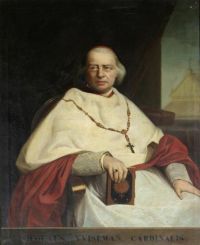
Nicholas Wiseman

Nicholas Wiseman

Summary

Portrait of Nicholas Wiseman Nicholas Wiseman Judging from the past and present… (1864)

But, in thus strongly advocating an architecture not depending on private exertions, or individual taste, but possessed of stable maxims and a national character, am I contemplating the possibility of this mighty city being the victim of some frightful catastrophe, which may destroy, or devastate it, and leave but solitary pillars, or broken arches, on a huge plain, to mark the spot where throbbing millions once discoursed and did many good and great things?
Source: Wikisource

Portrait of Nicholas Wiseman Nicholas Wiseman Judging from the past and present… (1864)

On a coast as bare as the Campagna, stand the huge and yet elegant temples of Pæstum, more imposing by the solitude which surrounds them, fresh, comparatively, and young, while all else has perished. And in Sicily there yet stand at Segeste, at Salinuntum, and at Agrigentum, similar monuments of man's genius, skill, and strength; columns erect, unmoved, upon their platforms, or as at Salinuntum, laid on the ground like soldiers slain in battle, still keeping their ranks, after the earthquake which overthrew, but could not destroy, the magnificent work of remote ages.
Source: Wikisource

Portrait of Nicholas Wiseman Nicholas Wiseman Judging from the past and present… (1864)

The aqueducts are beautiful objects while stalking across the country in their naked simplicity; and so does the viaduct of a railway connecting two hills often become a graceful addition to the landscape. But in passing, or cutting, through the midst of a city, it is very different. Can any one imagine that the aqueducts of Imperial Rome strode along as they did outside the wall, without a marble clothing, where they emerged into the public sight, or that they traversed the Forum, or climbed the Capitol, or Palatine, in their inornate suit of grey peperino?
Source: Wikisource

Get perspective with Kwize: daily news enlightened by great literature