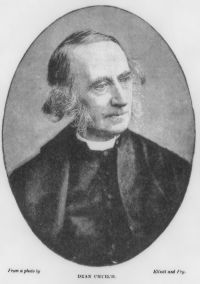
R. W. Church

R. W. Church

Summary

Portrait of R. W. Church R. W. Church Occasional Papers

They viewed religion as if projected on a background of natural and moral mystery, and surrounded by it—an infinite scene, in which our knowledge is like the Andes and Himalayas in comparison with the mass of the earth, and in which conscience is our final guide and arbiter. No one ever brought out so impressively the sense of the impenetrable and tremendous vastness of that amid which man plays his part.
Source: Gutenberg

Portrait of R. W. Church R. W. Church Occasional Papers

Can the enthusiasm for the divinity of human nature stand the test of clear, unsparing observation? Would it not issue in such an estimate of human nature as Mahomet took? "A deification of humanity upon its own grounds, an exaltation which is all height and no depth, wants power because it wants truth. It is not founded upon the facts of human nature, and therefore issues in vain and vapid aspiration, and injures the solidity of man's character." As he says, "The Gospel doctrine of the Incarnation and its effects alone unites the sagacious view of human nature with the enthusiastic."
Source: Gutenberg

Portrait of R. W. Church R. W. Church Occasional Papers

The history of the world presents a large range of instances to test the singular assertion that death is so "absurd" that "the people" cannot believe that great and good men literally die. But would it be easy to match the strangeness of a philosopher and a man of genius gravely writing this down as a reason—not why, at the interval of centuries, a delusion should grow up—but why, on the very morrow of a crucifixion and burial, the disciples should have believed that all the dreadful work they had seen a day or two before was in very fact and reality reversed?
Source: Gutenberg

Get perspective with Kwize: daily news enlightened by great literature