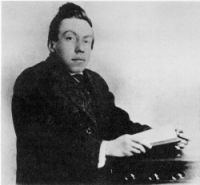
Randolph Silliman Bourne

Randolph Silliman Bourne

Summary

Portrait of Randolph Silliman Bourne Randolph Silliman Bourne The Gary Schools (1916)

The visitor who goes to-day to Gary finds a typically varied American city, rather better built than the average, and rather unusually favored in its open spaces. Situated within thirty miles of Chicago, the city presents a rather pleasing contrast to the long chain of industrial towns that stretches for miles in every direction across the treeless prairie. With a well-built business section, lines of residence streets, handsome public buildings and churches, electric cars and taxi-cabs, Gary has a settled air of community life unusual even for an older town.
Source: Gutenberg

Portrait of Randolph Silliman Bourne Randolph Silliman Bourne The Gary Schools (1916)

The organization of the manual work as a part of the regular curriculum prevents the narrow specialization of the trade school. It tends to turn the young worker out, not as a part of the industrial machine fitted to do only one thing, but equipped to meet a dynamic, rapidly changing industrial world which demands above all things versatility, and which scraps methods and machines as ruthlessly as it does men. Only the man of rounded training and resourcefulness who can turn his hand quickly to a variety of occupations has a chance to-day to rise above the mass.
Source: Gutenberg

Portrait of Randolph Silliman Bourne Randolph Silliman Bourne The Gary Schools (1916)

This is another illustration of that constant effort to make the pupils realize the meaning of what they are doing and what is around them. The effort of the Gary education is to make the child acquainted with the purposes of his school. He is not taught as an inferior who must take without question wisdom from immensely superior teachers, but as an equal and democratic citizen of his school community, learning wherever and whenever he can.
Source: Gutenberg

Get perspective with Kwize: daily news enlightened by great literature