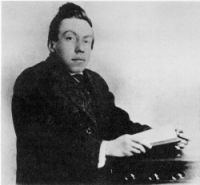
Randolph Silliman Bourne

Biographical details

Portrait of Randolph Silliman Bourne Randolph Silliman Bourne,  Youth and Life (1913)

“ It is unfair, perhaps, to blame parents and teachers, as we sometimes do in youth, for consciously biasing our child-minds in a falsely idealistic direction; for the child will infallibly idealize even his poorest of experiences. His broken glimpses and anticipations of his own future show him everything that is orderly, happy, and beautifully fit. He sees his grown-up life as old age, itself a sort of reversed childhood, sees its youth. The passing of childhood into youth is, therefore, like suddenly being turned from the cosy comfort of a warm fireside to shift for one’s self in the world. ”

Source: Gutenberg

Portrait of Randolph Silliman Bourne Randolph Silliman Bourne,  History of a literary radical, and other essays (1920)

“ To hear that one ought to love this or that person; or to hear loyalty spoken of, as the older generation so often speaks of it, as if it consisted in an allegiance to something which one no longer believes in,—this is what soonest liberates those forces of madness and revolt which bewilder spiritual teachers and guides. It is those dry channels of duty and obligation through which no living waters of emotion flow that it is the ideal of the younger generation to break up. They will have no network of emotional canals which are not brimming, no duties which are not equally loves. ”
Source: Gutenberg

Portrait of Randolph Silliman Bourne Randolph Silliman Bourne,  Youth and Life (1913)

“ Youth needs courage, that salt of the virtues, for if youth has its false hopes, it has its false depressions. That strange melancholy, when things seem to lose their substance and the world becomes an empty shell, is the reverse shield of the elation of youth. To face and overcome it is a real test of the courage of youth. The dash and audacity, the daring and self-confidence of youth, are less fine than this simple courage of optimism. Youth needs courage, too, when its desires do not come true, when it meets suspicion or neglect, and when its growth seems inexorably checked by circumstance. ”
Source: Gutenberg

Get perspective with Kwize: daily news enlightened by great literature