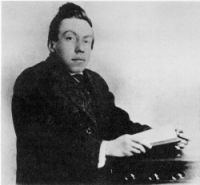
Randolph Silliman Bourne

Randolph Silliman Bourne

Summary

Portrait of Randolph Silliman Bourne Randolph Silliman Bourne History of a literary radical, and other essays (1920)

Those who came to find liberty achieve only license. They become the flotsam and jetsam of American life, the downward undertow of our civilization with its leering cheapness and falseness of taste and spiritual outlook, the absence of mind and sincere feeling which we see in our slovenly towns, our vapid moving pictures, our popular novels, and in the vacuous faces of the crowds on the city street. This is the cultural wreckage of our time, and it is from the fringes of the Anglo-Saxon as well as the other stocks that it falls. America has as yet no impelling integrating force.
Source: Gutenberg

Portrait of Randolph Silliman Bourne Randolph Silliman Bourne History of a literary radical, and other essays (1920)

Only thus shall we conserve the American spirit and saturate the next generation with those qualities which are our strength. Only thus can we take our rightful place among the cultures of the world, to which we are entitled if we would but recognize it. We shall never be able to perpetuate our ideals except in the form of art and literature; the world will never understand our spirit except in terms of art. When shall we learn that “culture,” like the kingdom of heaven, lies within us, in the heart of our national soul, and not in foreign galleries and books?
Source: Gutenberg

Portrait of Randolph Silliman Bourne Randolph Silliman Bourne History of a literary radical, and other essays (1920)

To hear that one ought to love this or that person; or to hear loyalty spoken of, as the older generation so often speaks of it, as if it consisted in an allegiance to something which one no longer believes in,—this is what soonest liberates those forces of madness and revolt which bewilder spiritual teachers and guides. It is those dry channels of duty and obligation through which no living waters of emotion flow that it is the ideal of the younger generation to break up. They will have no network of emotional canals which are not brimming, no duties which are not equally loves.
Source: Gutenberg

Get perspective with Kwize: daily news enlightened by great literature