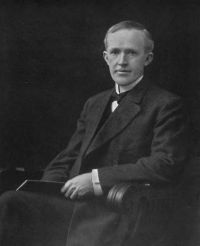
Samuel McChord Crothers

Samuel McChord Crothers

Summary

Portrait of Samuel McChord Crothers Samuel McChord Crothers Humanly Speaking

The riddle of existence is seen not from the Old World point of view, but from that of the new. It is of the nature of a surprise. The Sphinx of Emerson is not carved in stone. It is not silent and motionless, waiting for answers that do not come.
It is the American Sphinx leading in a game of hide-and-seek. The mystery of existence baffles us, not because there is no answer, but because there are so many. They are infinite in number, and all of them are true.
Source: Gutenberg

Portrait of Samuel McChord Crothers Samuel McChord Crothers Humanly Speaking

He was as distinctly American as was Daniel Boone. Daniel Boone was no renegade taking to the woods that he might relapse into savagery. He was a civilized man who preferred to be the maker of civilization rather than to be its victim. He preferred to blaze his own way through the forest. When he saw the smoke of a neighbor's chimney it was time for him to move on. So William James was led by instinct from the crowded highways to the dim border-lands of human experience. He preferred to dwell in the debatable lands. With a quizzical smile he listened to the dignitaries of philosophy.
Source: Gutenberg

Portrait of Samuel McChord Crothers Samuel McChord Crothers Humanly Speaking

That the end justifies the means may be a dangerous doctrine in ethics, but much may be said for it in literature. The situation is like that of a middle-aged gentleman beset by a small boy on a morning just right for snowballing. "Give me leave, mister?" cries the youthful sharpshooter. The good-natured citizen gives leave by pulling up his coat-collar and quickening his pace. If the small boy can hit him, he is forgiven, if he cannot hit him, he is scorned. The fact is that Dickens with a method as broad and repetitious as that of Nature herself does succeed in hitting our fancy.
Source: Gutenberg

Get perspective with Kwize: daily news enlightened by great literature