Summary

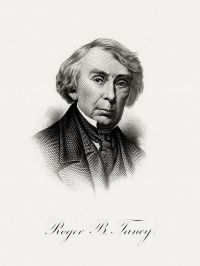
Portrait of Roger B. Taney Roger B. Taney Martin v. Waddell — Opinion of the Court

But the power which may be exercised by the sovereignty of the state is nothing more than what is called the jus regium; the right of regulating, improving and securing the same, for the benefit of every individual citizen. The sovereign power itself, therefore, cannot, consistently with the principles of the law of nature, and the constitution of a well-ordered society, make a direct and absolute grant of the waters of the state, divesting all the citizens of a common right. It would be a grievance which never could be long borne by a free people.
Source: Wikisource

Portrait of Roger B. Taney Roger B. Taney Martin v. Waddell — Opinion of the Court

By the treaty of 1783, the king of Great Britain ceded all his right and sovereignty over the United States. Did not the rivers and the soil under them pass, without apt and special words to include all his regalities? This was a newly-acquired territory, then a wilderness; the settlement and improvement of it were great objects with the crown. In order to effect this, it was intended to hold out great inducements to Englishmen and others, to come over and inhabit it. Self-government was always a favorite object with the people of England, who were strongly imbued with a love of liberty
Source: Wikisource

Portrait of Roger B. Taney Roger B. Taney Martin v. Waddell — Opinion of the Court

If lands under water can be granted, and are actually granted, the grantees must, of course, acquire all the right to the use and enjoyment of such lands of which they are susceptible, as private property, as much so as the dry land; and there can be no grounds for any implied reservation of ungranted rights, in the one case, more than in the other; and the grant of the soil carries with it, of course, all the uses to which it may be applied, among which is an exclusive or several fishery.
Source: Wikisource

Get perspective with Kwize: daily news enlightened by great literature