Summary

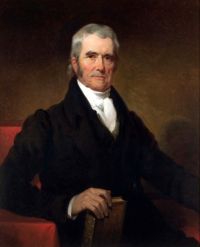
Portrait of John Marshall John Marshall Johnson v. M'Intosh — Opinion of the Court

This principle was, that discovery gave title to the government by whose subjects, or by whose authority, it was made, against all other European governments, which title might be consummated by possession.
The exclusion of all other Europeans, necessarily gave to the nation making the discovery the sole right of acquiring the soil from the natives, and establishing settlements upon it. It was a right with which no Europeans could interfere.
Source: Wikisource

Portrait of John Marshall John Marshall Johnson v. M'Intosh — Opinion of the Court

But the tribes of Indians inhabiting this country were fierce savages, whose occupation was war, and whose subsistence was drawn chiefly from the forest. To leave them in possession of their country, was to leave the country a wilderness; to govern them as a distinct people, was impossible, because they were as brave and as high spirited as they were fierce, and were ready to repel by arms every attempt on their independence.
Source: Wikisource

Portrait of John Marshall John Marshall Johnson v. M'Intosh — Opinion of the Court

The title by conquest is acquired and maintained by force. The conqueror prescribes its limits. Humanity, however, acting on public opinion, has established, as a general rule, that the conquered shall not be wantonly oppressed, and that their condition shall remain as eligible as is compatible with the objects of the conquest. Most usually, they are incorporated with the victorious nation, and become subjects or citizens of the government with which they are connected. The new and old members of the society mingle with each other
Source: Wikisource

Get perspective with Kwize: daily news enlightened by great literature