Summary

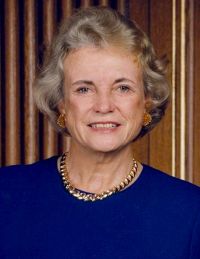
Portrait of Sandra Day O'Connor Sandra Day O'Connor Jimmy Swaggart Ministries v. Board of Equalization of California…

Ironically, appellant's theory, under which government may not tax "religious core" activities but may tax "nonreligious" activities, would require government to do precisely what appellant asserts the Religion Clauses prohibit: "determine which expenditures are religious and which are secular." Lemon, 403 U.S., at 621-622, 91 S.Ct., at 2115-2116.
Accordingly, because we find no excessive entanglement between government and religion in this case, we hold that the imposition of sales and use tax liability on appellant does not violate the Establishment Clause.
Source: Wikisource

Portrait of Sandra Day O'Connor Sandra Day O'Connor Jimmy Swaggart Ministries v. Board of Equalization of California…

For example, California treats the sale of a Bible by a religious organization just as it would treat the sale of a Bible by a bookstore; as long as both are in-state retail sales of tangible personal property, they are both subject to the tax regardless of the motivation for the sale or the purchase. There is no danger that appellant's religious activity is being singled out for special and burdensome treatment.
Source: Wikisource

Portrait of Sandra Day O'Connor Sandra Day O'Connor Jimmy Swaggart Ministries v. Board of Equalization of California…

The Free Exercise Clause accordingly does not require the State to grant appellant an exemption from its generally applicable sales and use tax. Although it is of course possible to imagine that a more onerous tax rate, even if generally applicable, might effectively choke off an adherent's religious practices, cf. Murdock, supra, 319 U.S., at 115, 63 S.Ct., at 876 (the burden of a flat tax could render itinerant evangelism "crushed and closed out by the sheer weight of the toll or tribute which is exacted town by town") , we face no such situation in this case.
Source: Wikisource

Get perspective with Kwize: daily news enlightened by great literature