Summary

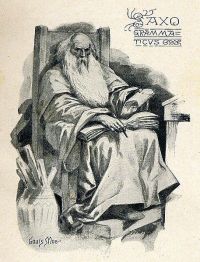
Portrait of Saxo Grammaticus Saxo Grammaticus,  The Danish History — Introduction

“ Now King Thidrec of Bern saw what Grimhild is doing, and speaks to King Attila. `See how that devil Grimhild, thy wife, is killing her brothers, the good warriors, and how many men have lost their lives for her sake, and how many good men she has destroyed, Huns and Amalungs and Niflungs; and in the same way would she bring thee and me to hell, if she could do it?' Then spake King Attila, `Surely she is a devil, and slay thou her, and that were a good work if thou had done it seven nights ago! ”
Source: Wikisource

Portrait of Saxo Grammaticus Saxo Grammaticus,  The Danish History — Introduction

“ CIVIL PROCEDURE. -- "Oaths" are an important art of early procedure, and noticed by Saxo; one calling the gods to witness and therefor, it is understood, to avenge perjury if he spake not truth.
"Testification", or calling witnesses to prove the steps of a legal action, was known, "Glum's Saga" and "Landnamaboc", and when a manslayer proceeded (in order to clear himself of murder) to announce the manslaughter as his act, he brings the dead man's head as his proof, exactly as the hero in the folk-tales brings the dragon's head or tongue as his voucher.
”
Source: Wikisource

Portrait of Saxo Grammaticus Saxo Grammaticus,  The Danish History — Introduction

“ The gods can disguise their form, change their shape, are often met in a mist, which shrouds them save from the right person; they appear and disappear at will. For the rest they have the mental and physical characteristics of the kings and queens they protect or persecute so capriciously. They can be seen by making a magic sign and looking through a witch's arm held akimbo. They are no good comates for men or women, and to meddle with a goddess or nymph or giantess was to ensure evil or death for a man. ”
Source: Wikisource

Get perspective with Kwize: daily news enlightened by great literature