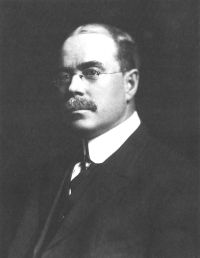
Shailer Mathews

Shailer Mathews

Summary

Portrait of Shailer Mathews Shailer Mathews The American Journal of Sociology (1896)

To speak of a Christian method of sociological investigation is quite as impossible. The investigation of social forces and results, the discovery of the true nature of society, can no more have an ethical—still less religious—character than the study of a crystal or a chemical compound.
But in the other sense in which the name of a science is used, no such criticism can hold. The moment an investigator attempts to formulate his results in propositions, that moment he injects into them his own characteristics.
Source: Wikisource

Portrait of Shailer Mathews Shailer Mathews The American Journal of Sociology (1896)

In other words, the very misconception of the Christians of the third and fourth centuries of the teachings of Jesus in regard to the kingdom is an evidence that they did not regard these teachings as anarchistic.
And, indeed, the whole philosophy of Christ in regard to man, both real and ideal, points to the same conclusion. The union which he holds up is not that of an aggregation, but is organic. The kingdom of God is the union of brothers over whom God himself is to reign.
Source: Wikisource

Portrait of Shailer Mathews Shailer Mathews The American Journal of Sociology (1896)

But unless our conception of the teaching of Jesus is altogether incorrect, not only would it be ill-advised to use the term anarchy in speaking of his teaching, but it would commit him to notions of government and society, which, if we may judge from his words, were utterly absent from his thought. For instance, much of the plausibility of this irenic anarchy depends upon the conception of the state as a mere coercive regulator of individuals who need an umpire to decide and enforce the extent to which each must yield to the other in the interest of social peace.
Source: Wikisource

Get perspective with Kwize: daily news enlightened by great literature