Sister Nivedita

Sister Nivedita

Summary

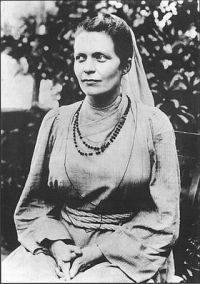
Portrait of Sister Nivedita Sister Nivedita Footfalls of Indian History (1915)

ELEPHANTA—THE SYNTHESIS OF HINDUISM
At a great moment in the history of India the caves of Elephanta were carved out of the hving rock. A moment of synthesis it was that ages had prepared; a moment of promise that would take milleniums to fulfil. The idea that we now call Hinduism had just arrived at theological maturity. The process of re-differentiation had not yet begun. The caves of Elephanta mark perhaps its greatest historic moment. In all religious sects the conflict of opinion is determined more by the facts of history and geography than by opposing convictions.
Source: Wikisource

Portrait of Sister Nivedita Sister Nivedita Footfalls of Indian History (1915)

Shadows wrought on shadows, silver-grey against the scarcely deeper darkness ; this in truth is the very Immanence of God in human life. On its right is the sculptured panel representing the universe according to the Saivite idea. Shiva and Parbati ride together on the bull, and again—as in the carving of Durga in the porch—the heavens behind them are like a chorus of song.
Source: Wikisource

Portrait of Sister Nivedita Sister Nivedita Footfalls of Indian History (1915)

Asoka owed as much to the political unity of India as to the wondrous vision which he had received from Buddha of all that it means to be a man, a human being, high born or low born, Aryan or non-Aryan.
But the question, Of what spiritual confraternity did Asoka hold himself a member?—becomes here of considerable importance. To belong to a new sect does not often have the effect of opening a man's heart to all about him in this fashion. Sects as a rule unite us to the few but separate us from the many. And here lies the meaning of the fact that Buddhism in India was no sect.
Source: Wikisource

Get perspective with Kwize: daily news enlightened by great literature