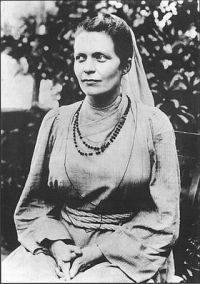
Sister Nivedita

Sister Nivedita

Summary

Portrait of Sister Nivedita Sister Nivedita Kali the Mother (1900)

That is to say, Nature itself is God, as truly as Nature's soul. "Are God and Nature then at strife?" cries, not only a great poet, but the whole heart of our western religion to-day. And far back from out of the dim centuries comes the hushed whisper of the Indian sages—"Look closer, brother! they are not even two, but one!" Under this aspect, the One Existence is known as Purush and Prakriti, Soul and Energy.
The highest representation of the Divine is always human.
Source: Wikisource

Portrait of Sister Nivedita Sister Nivedita Kali the Mother (1900)

For in that moment when the red rose of the love of God springs and blossoms in a man's heart,—so that he cries out: "Like as the hart panteth after the waterbrooks, so longeth my soul after Thee O God!"—in that moment, as Asia knows well, everything else falls away from him. All the manifold satisfactions of the flesh become a burden. Home and kindred and intercourse with the world are a bondage. Food and sleep and the necessities of the physical life seem indifferent or intolerable. And so it comes that the Great God of the Hindu imagination is a beggar.
Source: Wikisource

Portrait of Sister Nivedita Sister Nivedita Kali the Mother (1900)

But Ramakrishna in the garden of the Kali-temple, was a direct embodiment of the impulse to speak to each in his own language and tell him how to reach the goal. In this man's love there was no limitation anywhere. Let one be sincere, and neither race, nor history, nor stage of developement could cut him off. Each who came to him had his own place given to him, and kept it. His longing was for the salvation of every soul in a whole world. A universe from which one, most insignificant, was missing, could not have seemed perfect in his eyes.
Source: Wikisource

Get perspective with Kwize: daily news enlightened by great literature