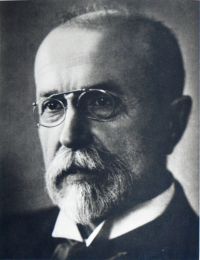
Tomáš Garrigue Masaryk

Tomáš Garrigue Masaryk

Summary

Portrait of Tomáš Garrigue Masaryk Tomáš Garrigue Masaryk The New Europe (1917)

To-day we feel that the warm blood of nations, shed in torrents all over Europe, compels all thinking men to face the decisive question: who is guilty of so hideous a crime as the present war? Like all its predecessors, this war is a question of conscience; but in it, as in them, we see the churches each following its own country. They do not lead—they are led. Foolish atheists are never tired of pointing to the fact that one and the same church is praying in Germany for a German, in France for a French victory
Source: Wikisource

Portrait of Tomáš Garrigue Masaryk Tomáš Garrigue Masaryk The New Europe (1918)

The war and its significance have knitted mankind closer together; humanity is to-day an organised unit, internationalism is much more intimate than it ever was; it has been created and renewed by this war and at the same time democratic views of society are everywhere strengthened—the fall of Tzarism is but one of the unexpected results of the war.
The unified organisation of all the nations of the world, of all humanity is the beginning of a new era, an era in which nations and all mankind will consciously control their development.
Source: Wikisource

Portrait of Tomáš Garrigue Masaryk Tomáš Garrigue Masaryk The New Europe (1917)

Let us see things clearly, and let us speak as politicians. What would the Allies say if Italy made a separate peace with our common enemy? Why are those people, who desire a separate peace with Austria, so nervous if the possibility of Russia making a separate peace is suggested? If Austria made a separate peace, that would mean an Austrian betrayal of Germany; Austria provoked the war; Germany used the occasion for her political aims, and, incidentally, saved Austria by forcing the Russians to retreat.
Source: Wikisource

Get perspective with Kwize: daily news enlightened by great literature