Summary

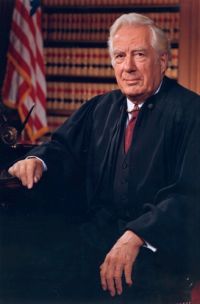
Portrait of Warren E. Burger Warren E. Burger Bivens v. Six Unknown Named Agents of Federal Bureau of Narcotics…

In characterizing the suppression doctrine as an anomalous and ineffective mechanism with which to regulate law enforcement, I intend no reflection on the motivation of those members of this Court who hoped it would be a means of enforcing the Fourth Amendment. Judges cannot be faulted for being offended by arrests, searches, and seizures that violate the Bill of Rights or statutes intended to regulate public officials. But we can and should be faulted for clinging to an unworkable and irrational concept of law.
Source: Wikisource

Portrait of Warren E. Burger Warren E. Burger Bivens v. Six Unknown Named Agents of Federal Bureau of Narcotics…

It is easy to predict our collective wrath and outrage. We, in common with all rational minds, would say that the police response must relate to the gravity and need; that a 'shoot' order might conceivably be tolerable to prevent the escape of a convicted killer but surely not for a car thief, a pickpocket or a shoplifter.
I submit that society has at least as much right to expect rationally graded responses from judges in place of the universal 'capital punishment' we inflict on all evidence when police error is shown in its acquisition.
Source: Wikisource

Portrait of Warren E. Burger Warren E. Burger Bivens v. Six Unknown Named Agents of Federal Bureau of Narcotics…

But in the same spirit we should be prepared to discontinue what the experience of over half a century has shown nither deters errant officers nor affords a remedy to the totally innocent victims of official misconduct.
I do not propose, however, that we abandon the suppression doctrine until some meaningful alternative can be developed. In a sense our legal system has become the captive of its own creation.
Source: Wikisource

Get perspective with Kwize: daily news enlightened by great literature