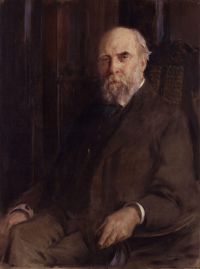
William Cosmo Monkhouse

William Cosmo Monkhouse

Summary

Portrait of William Cosmo Monkhouse William Cosmo Monkhouse Dictionary of National Biography (1901)

It is too early to fix precisely the position of Millais as an artist, but there is no doubt that he was one of the greatest painters of the nineteenth century, and that he did more than any other of his generation to infuse a new and healthy life into British art. There was nothing of the idealist or visionary in his designs, and he had not a great imagination ; but he could paint what he saw with a force and a truth which have seldom been excelled, and his intense love of nature and of his kind tilled his work with life and poetry.
Source: Wikisource

Portrait of William Cosmo Monkhouse William Cosmo Monkhouse Dictionary of National Biography (1901)

As a man Millais was frank, manly, and genial, not over-refined, but devoid of affectation. Though of no great intellectual power, he had a strong fund of common sense, and, if not a great reader, was fond of poetry (especially Tennyson and Keats) , of the best fiction, and of books of travel, and he could write graceful and humorous verses. In manner and appearance he resembled a country gentleman rather than an artist. He was devoted to his art, but not blind to the advantages of success and prosperity.
Source: Wikisource

Portrait of William Cosmo Monkhouse William Cosmo Monkhouse Dictionary of National Biography (1901)

As an artist Armitage took an important part in the movements for the restoration of fresco painting in England, and the decoration of the houses of parliament with historical designs. His early training on the continent and his employment by Delaroche upon a mural painting of a grand character influenced the direction of his art throughout his life. This art was cold, severe, and academic, but always lofty in aim and large in design. Armitage did not confine his interests entirely to art
Source: Wikisource

Get perspective with Kwize: daily news enlightened by great literature