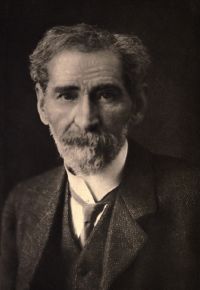
William Henry Hudson

William Henry Hudson

Summary

Portrait of William Henry Hudson William Henry Hudson British birds (1921)

The wood-pigeon is the handsomest, as well as the largest, of the British doves, its dove-grey tints being singularly delicate, soft, and harmonious, and their effect heightened by the white marks and touch of iridescent colour on the neck. On the ground its motions are deliberate, and have a graceful dignity which contrasts strongly with the hurried, eager manner of the rock-pigeon and stock-dove. When startled from its perch it rushes out with great violence and loud clapping of the wings.
Source: Gutenberg

Portrait of William Henry Hudson William Henry Hudson British birds (1921)

The nightingale so nearly resembles the robin in size, form, and manner that he might be taken for that bird but for his clear, brown colour. Like the robin, he feeds on the ground, seeking grubs and insects under the dead leaves, hopping rapidly by fits and starts, standing erect and motionless at intervals as if to listen, and occasionally throwing up his tail and lowering his head and wings, just as the robin does. He inhabits woods, coppices, rough bramble-grown commons, and unkept hedges, and loves best of all a thicket growing by the side of running water.
Source: Gutenberg

Portrait of William Henry Hudson William Henry Hudson British birds (1921)

When feeding on a carcase his appearance is not engaging: there is a lack of dignity in his sidling or ‘loping’ motions, and savage haste in tearing at the flesh, with a startled look round after each morsel. When disturbed from his repast the slow, cumbrous, flapping flight as he rises strongly reminds you of the vulture. He makes a nobler figure when soaring high in the air, or along the face of some huge beetling cliff that fronts the sea; for then his flight has power and ease as he falls and rises, playing, like a giant chough or jackdaw, with his mate.
Source: Gutenberg

Get perspective with Kwize: daily news enlightened by great literature