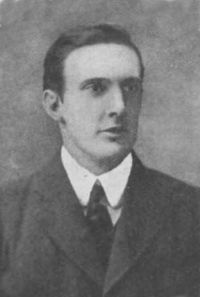
J. Lewis Bonhote

J. Lewis Bonhote

Summary

Portrait of J. Lewis Bonhote J. Lewis Bonhote Birds of Britain

We are on a hillside in Wales, below us lies the Irish Channel, with hardly a ripple on its surface, the hill itself is almost covered with a short growth of furze and heather, the intervening spaces being carpeted with short moss and grass, kept well cropped by the hardy race of sheep for which the Principality is justly famous. “Chuck, chuck”—this time we catch a glimpse of the bird, the beautiful white half-moon on his breast showing up clearly against the black of the rest of his plumage as he sits on one of the boulders that project through the vegetation and refuse to be hidden.
Source: Gutenberg

Portrait of J. Lewis Bonhote J. Lewis Bonhote Birds of Britain

He is at least by no means bad-looking—the chestnut of his back, his slate-blue head, black and white cheeks, and black throat all tend to add a touch of life and beauty to our gardens which they would otherwise lack; and then in summer he destroys countless noxious insects while feeding his brood, and in towns how companionable he is, hopping about our window-sills or on the roadway, evading the passing traffic with a knowledge born of long practice—surely these at least are compensations that entitle him to some regard.
Source: Gutenberg

Portrait of J. Lewis Bonhote J. Lewis Bonhote Birds of Britain

A cold autumn day, the clouds hang lowering in the sky; on one side flows the river, sullen, dark, and swollen by the recent rains, on the other stretch wild and bare meadows whose flat level is broken by clumps of nettles, thistles, and other coarse plants distasteful to cattle. One thing alone breaks the general dreariness—it is a flock of Goldfinches, who, as they hang in strange attitudes on the thistle heads, show the bright yellow of their wings, making it appear as though some plant, forgetful of the season, was about to burst into flower.
Source: Gutenberg

Get perspective with Kwize: daily news enlightened by great literature