Summary

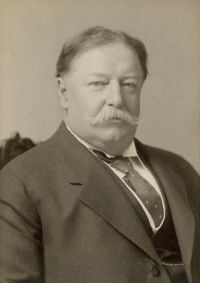
Portrait of William Howard Taft William Howard Taft Temco Electric Motor Company v…

The claim made for the invention is that the real gist if it is in the arrangement of the parts, all of which were old, so that the first vibration and shock would be taken up from the axle by the torsional spring, and then, having been divided up into vibrations, would be communicated through the torsional spring and the absorber to the leaf spring, and 'dampened down,' as the expression is, by its slower action, so as really to take up and absorb and make to disappear the shocks otherwise directly communicated from the road and the axle to the leaf spring.
Source: Wikisource

Portrait of William Howard Taft William Howard Taft Temco Electric Motor Company v…

It appears that the real owners of the patent, realizing that there were defects in the operation of the absorber that should be remedied, applied to the Patent Office for a patent which should substitute for the stanchions or guides, on which the hanger around the torsional spring moved up and down in a verticle direction, a fixed radius link. The torsional spring of the patent inclosed within the casing or hanger attached to the upright guide did not, in moving or sliding up and down, retain a vertical direction, but was sometimes tilted over by the weight of the car and its load.
Source: Wikisource

Portrait of William Howard Taft William Howard Taft Temco Electric Motor Company v…

It was upon that theory, that the Storrie patent was an improvement on the Thompson patent, that the Circuit Court of Appeals of the Sixth Circuit, in the suit between the Temco Company and the K-W Ignition Company decided that it could allow only recovery for royalties and not for profits. 283 F. 873, 876, 877. It is well established that an improver cannot appropriate the basic patent of another, and that the improver without a license is an infringer, and may be sued as such.
Source: Wikisource

Get perspective with Kwize: daily news enlightened by great literature