Summary

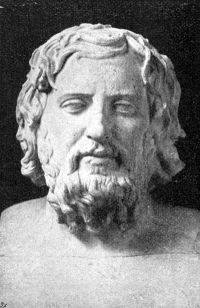
Portrait of Xenophon Xenophon Cyropaedia: The Education of Cyrus

Let not cold bite thee in winter nor heat inflame thee in summer,' I say there is no law that could compel us to obey; for it is our nature to be swayed by these forces. But love is voluntary; each man loves to himself alone, and according as he chooses, just as he chooses his cloak or his sandals."
(12) "Then," said Cyrus, "if love be voluntary, why cannot a man cease to love when he wishes? I have seen men in love," said he, "who have wept for very agony, who were the very slaves of those they loved, though before the fever took them they thought slavery the worst of evils.
Source: Gutenberg

Portrait of Xenophon Xenophon Cyropaedia: The Education of Cyrus

A man will toil day and night to make himself an orator, yet oratory is not the one aim of his existence: his hope is to influence men by his eloquence and thus achieve some noble end. So too with us, and those like us, who are drilled in the arts of war: we do not give our labours in order to fight for ever, endlessly and hopelessly, we hope that we too one day, when we have proved our mettle, may win and wear for ourselves and for our city the threefold ornament of wealth, of happiness, of honour.
Source: Gutenberg

Portrait of Xenophon Xenophon Cyropaedia: The Education of Cyrus

And the Hyrcanian chieftain said, "For my part, if you Medes turn back to-day I shall say it was the work of some evil genius, who could not brook the fulfilment of your happiness. For no human heart could think of retiring when the foe is in flight, refusing to receive his sword when he surrenders it, rejecting him when he offers himself and all that he calls his own; above all, when we have a prince of men for our leader, one who, I swear it by the holy gods, takes delight to do us service, not to enrich himself."
Source: Gutenberg

Get perspective with Kwize: daily news enlightened by great literature