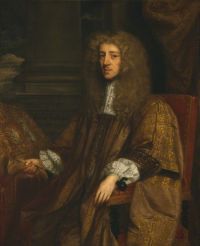
Anthony Ashley Cooper, 1st Earl of Shaftesbury

Definition and stakes

Osmund Airy 1911 Encyclopædia Britannica, Volume 24… (1911)

SHAFTESBURY, ANTHONY ASHLEY COOPER, 1st Earl of (1621–1683) , son of Sir John Cooper of Rockbourne in Hampshire, and of Anne, the only child of Sir Anthony Ashley, Bart., and was born at Wimborne St Giles, Dorset, on the 22nd of July 1621. His parents died before he was ten years of age, and he inherited extensive estates in Hampshire, Wiltshire, Dorsetshire and Somersetshire, much reduced, however, by litigation in Chancery. He lived for some time with Sir Daniel Norton, one of his trustees, at Southwick, and upon his death in 1635 with Mr Tooker, an uncle by marriage, at Salisbury.
Source: Wikisource

Osmund Airy 1911 Encyclopædia Britannica, Volume 24… (1911)

With nine other peers he presented a petition to the king in November, praying for the meeting of parliament, of which Charles took no notice. In April, upon the king’s declaration that he was resolved to send for James from Scotland, Shaftesbury advised the popular leaders at once to leave the council, and they followed his advice. In March we find him unscrupulously eager in the prosecution of the alleged Irish Catholic plot. Upon the king’s illness in May he held frequent meetings of Monmouth’s friends at his house to consider how best to act for the security of the Protestant religion.
Source: Wikisource

Osmund Airy 1911 Encyclopædia Britannica, Volume 24… (1911)

Much of Shaftesbury’s career, increasingly so as it came near its close, is incapable of defence; but it has escaped most of his critics that his life up to the Restoration, apparently full of inconsistencies, was evidently guided by one leading principle, the determination to uphold the supremacy of parliament, a principle which, however obscured by self-interest, appears also to have underlain his whole political career.
Source: Wikisource

Get perspective with Kwize: daily news enlightened by great literature