Badaga

Definition and stakes

W.H.R.Rivers,  The Todas (1906)

“ The only part played by a Badaga at a Toda funeral is that the bell called tukulir mani may be kept by a Badaga or a Kota, and, as I have suggested on p. 377, the whole ceremony with the calf in which this bell is used may have been borrowed from the Badagas. The idea of a thread bridge between this world and the next is said to be common to Todas and Badagas, but I have no evidence to show which has borrowed from the other. [634]
In the ordinary life of the people there is more evidence of influence.
”
Source: Gutenberg

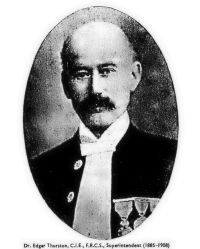
Portrait of Edgar Thurston Edgar Thurston,  Castes and Tribes of Southern India (1909)

“ Her labour in the field is considered to be worth one rupee per day, while an average male Badaga earns merely three annas. A Badaga woman, who has not her own acres to cultivate, finds work on some other lands. She thus works hard for her husband and family, and is quite content with the coarsest food — the korali (Setaria italica) flour—leaving the better food to the male members of the family. This fact, and the hard work the Badaga women have to perform, may perhaps account to some extent for the slight build of the Badagas as a race. ”
Source: Wikisource

John Welsh Dulles,  Life in India (1855)

“ A large share of the agricultural labours falls to the lot of the women, who, as in all heathen countries, are made the drudges of the family. Although neat in their villages, the Badagas cannot be praised for cleanliness of person or of dress. As they are in the habit of oiling their bodies, and not in the habit of washing their robes, the latter become so fragrant in the process of time, that a blind man would have no difficulty in telling when a Badaga passed him in the road. ”
Source: Wikisource

Get perspective with Kwize: daily news enlightened by great literature