“ Kneeling in front of the tomb, the necromancer began the third verse. As he spoke, the former phenomena were still to be remarked. As he continued, a number of ghosts rose from their graves, and advanced round the kneeling figures in a circle. As he concluded, with a loud bang the door of the vault flew open, and there in blue light stood Bluebeard in his blue uniform, waving his blue sword, and flashing his blue eyes round about!"Speak now, or you are lost," said the necromancer, to Fatima. But, for the first time in her life, she had not a word to say. ”
Necromancer
Definition and stakes
The necromancer, a figure steeped in myth and moral ambiguity, embodies humanity's enduring fascination with the boundary between life and death. From Lucius M. Sargent’s condemnation of spiritualist practices to Ludovico Ariosto’s integration of necromancy into chivalric quests, writers have examined this theme from multiple perspectives—whether as literal practitioners, metaphorical deceivers, or symbols of forbidden wisdom.
Mark Twain mocks the archetype, while Arthur Conan Doyle elevates deduction to a form of supernatural precision. These varied depictions highlight necromancy as a reflection of societal anxieties and intrigue surrounding the paranormal.
Quotes about “necromancer”
Edwin Lester Arnold, Lieut. Gullivar Jones: His Vacation (1905)
“ On a hot day like this it ought to be a pleasant saunter for a spirit such as yourself." "Not daunted," I answered coldly, turning on my heels towards the door, "only marvelling that your majesty's skull and your necromancer's could not between them have devised a harder task." ”
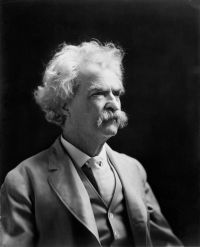 Mark Twain,
A Connecticut Yankee in King Arthur's Court
Mark Twain,
A Connecticut Yankee in King Arthur's Court
“ But it never occurred to one of them to reflect that if I was such a wonderful necromancer as I was pretending to be, I ought not to need salves or instructions, or charms against enchantments, and, least of all, arms and armor, on a foray of any kind—even against fire-spouting dragons, and devils hot from perdition, let alone such poor adversaries as these I was after, these commonplace ogres of the back settlements. ”
Lucius M. Sargent, Dealings with the Dead, Volume 2…
“ The old Roman tar ordered the sacred pullets, then in their cage, to be brought before him, and, kicking them overboard, exclaimed, “let them drink then.”The etymology of the word necromancy, νεκρος μάντις, shows its direct application to the scandalous orgies, which are matters of weekly exhibition, in many of our villages and cities, under the name of spiritual knockings. Though Sir Thomas Browne could mark, learn, and inwardly digest a witch, a necromancer was beyond his powers ”
Lucius M. Sargent, Dealings with the Dead, Volume 2…
“ In the strictest sense, the Fishes and the Foxes and their numerous imitators are necromancers, of course.This impious and eminently pernicious practice has been condemned, in every age, and by every civilized nation. It was condemned, by the law of Moses—“There shall not be found among you any one, that maketh his son or his daughter to pass through the fire, or that useth divination, or an observer of times, or an enchanter, or a witch, or a charmer, or a consulter with familiar spirits, or a wizard or a necromancer. ”
Margaret Sherwood, The Princess Pourquoi (collection… (1907)
“ Day after day the Necromancer stood in the market-place, and put his lips secretly to his colored bags, and spoke. He had searched all the copy-books of the kingdom, and had taken familiar truths, such as: "The good die young;" "To be selfish is to be miserable;" "Haste makes waste;" "A bird in the hand is worth two in the bush;" ”
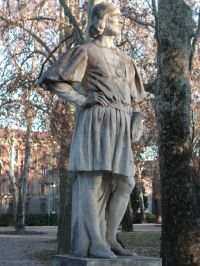 Ludovico Ariosto,
Orlando Furioso — Canto IV
(1516)
Ludovico Ariosto,
Orlando Furioso — Canto IV
(1516)
“ The necromancer keeps, the work of spell." (The host relates) "of steel, so fair and bright, All nature cannot match the wonderous shell. There many cavaliers, to prove their might, Have gone, but none returned the tale to tell. So that I doubt, fair sir, the thief enthralls Or slays whoever in the encounter falls." VIII The watchful maid attends to every thing, Glad at her heart, and trusting to complete (What she shall compass by the virtuous ring) The downfall of the enchanter and his seat. ”
“ Produce the languishing vestal, so that the arts of the necromancer may sustain her. But stay, my boy; before we go further, may I suggest that you conform to the conventional practice of confiding the name she goes by among men? ”
John M. Taylor, The Witchcraft Delusion in Colonial Connecticut…
“ Yet did he bid his servants to inquire out for him some woman that was a necromancer, and called up the souls of the dead, that so he might know whether his affairs would succeed to his mind; for this sort of necromantic women that bring up the souls of the dead, do by them foretell future events. ”
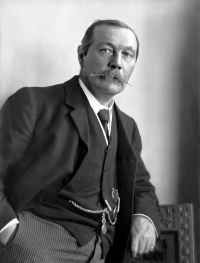 Arthur Conan Doyle,
A Study in Scarlet
(1887)
Arthur Conan Doyle,
A Study in Scarlet
(1887)
“ His conclusions were as infallible as so many propositions of Euclid. So startling would his results appear to the uninitiated that until they learned the processes by which he had arrived at them they might well consider him as a necromancer. ”
 Thomas Greenhill,
ΝΕΚΡΟΚΗΔΕΙΑ; Or, the Art of Embalming…
Thomas Greenhill,
ΝΕΚΡΟΚΗΔΕΙΑ; Or, the Art of Embalming…
“ In like manner they had a Custom, that when ever a King or Prince dy’d, all his Officers were instantly oblig’d to slash themselves with Knives in some visible part of their Bodies; insomuch, that he who was observ’d to have most Wounds, was always look’d upon to be the greatest Mourner. All which Ceremonies being in themselves superstitious, and no doubt invented by the Devil, forasmuch as the Egyptians were all naturally Necromancers, Magicians, 248Wizzards and Astrologers, and for that they were not only a damage to the Living, but also no Advantage to the Dead ”
Various, Harper's New Monthly Magazine, Vol…
“ They were, in fact, people that had been dead for centuries, but that, for reasons best known to themselves, had returned to this upper earth, walked about among us, and were undistinguishable, except by the most learned of necromancers, from authentic men of flesh and blood. ”
 Clement of Alexandria,
Ante-Nicene Christian Library/Volume IV
(1867)
Clement of Alexandria,
Ante-Nicene Christian Library/Volume IV
(1867)
“ Then, those who have put faith in necromancers, receive from them amulets and charms, to ward off evil forsooth; and will you not allow the heavenly Word, the Saviour, to be bound on to you as an amulet, and, by trusting in God's own charm, be delivered from passions which are the diseases of the mind, and rescued from sin?—for sin is eternal death. ”
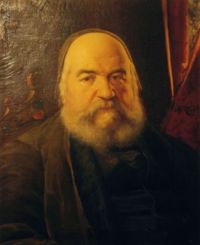 Éliphas Lévi,
The history of magic
(1922)
Éliphas Lévi,
The history of magic
(1922)
“ As a fact, were it permitted anyone to attract, by means of conjurations, the souls floating in darkness but aspiring towards the light, such a person would be begetting retrograde and posthumous children, whom he must nourish with his own blood and with his own soul. Necromancers are makers of vampires, and they deserve no pity if they die devoured by the dead. ”
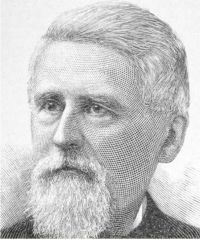 Henry Charles Lea,
A History of the Inquisition of the Middle Ages…
Henry Charles Lea,
A History of the Inquisition of the Middle Ages…
“ These sorcerers and diviners who pretend to reveal the future and the unknown by augury, or lots, or hydromancy, or crystallomancy, or by the head of a dead man, or the palm of a virgin, are deceivers. So are necromancers who work by the invocation of evil spirits, which is displeasing to God and injurious to man. Philtres and love-potions and figurines, to inspire desire or aversion, are also condemned as often causing death and permanent infirmity, and all these practitioners and cheats are to be put to death when duly convicted, while those who shelter them are to be banished. ”
King of England James I, Daemonologie
“ And yet is there no comparison, when this is done, betuixt the power of God, and of the Deuill. As to their forme of extasie and spirituall transporting, it is certaine the soules going out of the bodie, is the onely difinition of naturall death: and who are once dead, God forbid wee should thinke that it should lie in the power of all the Deuils in Hell, to restore them to their life againe: Although he can put his owne spirite in a dead bodie, which the Necromancers commonlie practise, as yee haue harde. ”
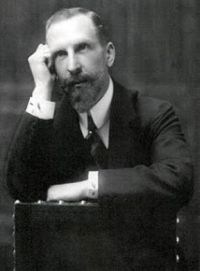 Franz Cumont,
After Life in Roman Paganism
Franz Cumont,
After Life in Roman Paganism
“ The Pythagoreans were indeed often necromancers, convinced defenders of spiritualism, in which, as we have said (p. 62) , they sought an immediate proof of the immortality of the soul, and by their doctrines they contributed to keeping alive the superstitious fear attached to omission of burial.But they were no more than theorists as to a belief which was widespread and which the invasion of Oriental magic was to revive. The curse-tablets often evoke, together with other demons, “those who are deprived of a sacred tomb” (ἄποροι τῆς ἱερᾶς ταφῆς) . ”
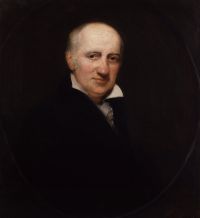 William Godwin,
Lives of the Necromancers
William Godwin,
Lives of the Necromancers
“ NECROMANCY. Last of all we may speak of necromancy, which has something in it that so strongly takes hold of the imagination, that, though it is one only of the various modes which have been enumerated for the exorcise of magical power, we have selected it to give a title to the present volume.There is something sacred to common apprehension in the repose of the dead. They seem placed beyond our power to disturb. "There is no work, nor device, nor knowledge, nor wisdom in the grave." ”
William Godwin,
Lives of the Necromancers
“ To violate the sepulchre therefore for the purpose of unholy spells and operations, as we read of in the annals of witchcraft, cannot fail to be exceedingly shocking. To call up the spirits of the departed, after they have fulfilled the task of life, and are consigned to their final sleep, is sacrilegious. Well may they exclaim, like the ghost of Samuel in the sacred story, "Why hast thou disquieted me?"There is a further circumstance in the case, which causes us additionally to revolt from the very idea of necromancy, strictly so called. Man is a mortal, or an immortal being. ”
Hugo Erichsen, The cremation of the dead
“ The ancient Romans believed in immortality, and yet they believed in burning the bodies of their dead. Urn burial was certainly quite as decent as the practice of interment; and urns containing the ashes of the dead were more picturesque than coffins. Can any one suppose that it would be more impossible for God to raise up a body at the resurrection, if needs be, out of elementary particles which had been liberated by the burning, than it would be to raise up a body from dust, and from the elements of bodies which had passed into the structure of worms? ”
“ The bodies leapt forward in the box, straining against the stake, and a horrible, drawn-out wail shattered the stillness of the tomb. The priest dropped to his knees and I clapped my hands over my ears, but the dreadful shriek penetrated. My stomach turned over and I retched. The Good Father followed suit. We were no supermen and our bodies and our very souls revolted against this monstrous thing."Let us finish, my son," the priest said slowly, after a time, his face the color of ashes. "We must bury these dead, that they may sleep in consecrated ground." ”
Duane W. Rimel and H. P. Lovecraft, Weird Tales (1937)
“ Now I can but wish for that which once was mine; that which every man blessed of God ought to have at death; that which I saw in that awful moment in the ancient burial ground when I raised the lid on the coffin—my own shrunken, decayed, and headless body. ”
Portal:The Folk-Lore Society, The Folk-Lore Journal (1887)
“ The lid was then screwed back on the coffin, and the remains were again lowered into the grave, which was at once filled up. It was learned that the women were of a very superstitious nature, and that they believed that if a corpse is buried with a shroud pinned up, instead of sewed, the soul will be confined to the grave for eternity, and the persons guilty of the mistake will be haunted till death by the ghost of the victim. ”
Anonymous, The secrets of black arts! (1900)
“ Necromancy has its name because it works on the bodies of the dead, and gives answers by apparitions of the dead, and subterraneous spirits, alluring them into the carcasses of the dead by charms and infernal invocations, and by deadly sacrifices and wicked oblations. ”
Gordon Hall Gerould, The Grateful Dead; the history of a folk story
“ For the burial of the corpse it substitutes a good deed, which is entirely different from the original trait. Yet it is evident that we have to do with The Grateful Dead, after all, since the divine image is rescued from senseless contumely and God himself appears in the rôle of the thankful ghost. It is evident also that the theme is combined with The Poison Maiden. Though we do not hear of any misadventures of other men with the priest’s daughter, the marvels which attend her purification indicate the danger in which the hero stood. ”
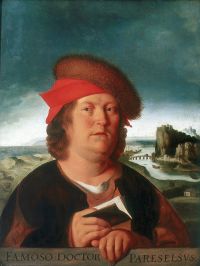 Paracelsus,
A New Light of Alchymie
Paracelsus,
A New Light of Alchymie
“ Necromancy draws forth its signs by the stars of Death, which we call Evestra, which are prophetical spirits, signing the body of the sick, and dying man with red, blue, and purple spots, which are certaine signs of death, in the third day of their rising. ”
Margaret Bertha Synge, A Short History of Social Life in England (1906)
“ As in the case of the Stone Man and the Celt, we look into the tombs of the dead to learn the manners and customs of the living. The Romans dealt with their dead either by cremation or burial in wooden, clay, or lead coffins placed in stone sarcophagi The Christian ideal was dawning slowly, and the old superstition was still deeply rooted in the minds of the people that articles of various kinds buried in the tombs would add to the comfort of the departed spirits. ”

“ The ravages of death break in upon them; how great are the cares which are now lavished upon those whom they have lost! They bear the corpse into its cavernous sepulchre; some weapons, an amulet, and perhaps an urn, form the whole of the funeral furniture. A slab of stone prevents the inroad of wild beasts. ”
“ I only wanted to suppose necromancy for the moment a fact, and put it at its best: suppose the magician could do for you all he professed, what would it amount to?—Only this—to bring before your eyes a shadowy resemblance of the form of flesh and blood, itself but a passing shadow, in which the man moved on the earth, and was known to his fellow-men? ”
Lucius M. Sargent, Dealings with the Dead, Volume 1…
“ The desire is almost universal, that, when summoned to lie down in the grave, the dead may never be disturbed, by the hand of man—that our remains may return quietly to dust—unobserved by mortal eye. There is no part of this humiliating process, that is not painful and revolting to the beholder. Of this the ancients had the same impression. Cremation and embalming set corruption and the worm at defiance. ”
Various, The Atlantic Monthly, Volume 02…
“ Their burial-ground was a cemetery, that is, a sleeping-place; they regarded the dead as put there to await the awakening; the body was depositus, that is, intrusted to the grave, while the heathen was situs or sepultus, interred or buried,—the words implying a final and definitive position. And as the Christian dormit or quiescit, sleeps or rests in death, so the heathen is described as abreptus, or defunctus, snatched away or departed from life.Again, the contrast between the inscriptions is marked, and in a sadder way, by the difference of the expressions of mourning and grief. ”
Chambers's Twentieth Century Dictionary…
“ Nec′romancer, one who practises necromancy: a sorcerer; Nec′romancy, the art of revealing future events by calling up and questioning the spirits of the dead: enchantment.—adjs. Necroman′tic, -al, pertaining to necromancy: performed by necromancy.—adv. Necroman′tically.—adj. Necroph′agous, feeding on carrion.—ns. Necroph′ilism, a morbid love for the dead; Necrophō′bia, a morbid horror of corpses.—adj. Necroph′orous, carrying away and burying dead bodies, esp. of beetles of the genus Necrophorus.—n. ”
 James George Frazer,
The Belief in Immortality and the Worship of the Dead…
James George Frazer,
The Belief in Immortality and the Worship of the Dead…
“ Then addressing the chiefs and the new king, the priest spoke as follows: "I will now make known to you the rules to be observed respecting persons to be sacrificed on the burial of his body. If you obtain one [Pg 426] man before the corpse is removed, one will be sufficient; but after it leaves this house four will be required. If delayed until we carry the corpse to the grave, there must be ten; but after it is deposited in the grave, there must be fifteen. To-morrow morning there will be a tabu, and if the sacrifice be delayed until that time, forty men must die." ”
 Louisa May Alcott,
The Mysterious Key and What It Opened
Louisa May Alcott,
The Mysterious Key and What It Opened
“ Standing in the tomb where the air was close and heavy, the pale glimmer of the lantern showed piles of moldering coffins in the niches, and everywhere lay tokens of decay and death. The man drew his hat lower over his eyes, pulled the muffler closer about his mouth, and surveyed the spot with an undaunted aspect, though the beating of his heart was heard in the deep silence. Nearest the door stood a long casket covered with black velvet and richly decorated with silver ornaments, tarnished now. ”
Hugo Erichsen, The cremation of the dead
“ If the guardians of consecrated sepulchres, in which people have paid an honest fee to be buried, are to dig them up and cart them off as in England, or make a show of them as here, why, I can only say that cremation will gain a good many converts. Any one would prefer urn burial to the chance of being thus made a spectacle. So good, too, it must be for the rising population to take off the edge of any salutary horror they may feel at death and decay, or of reverence for the dead. ”
