“ When the young man had told his story and produced his treasure he paused. The banker scarcely glanced at it, but said, impatiently: "Well, your papers?" "My papers?" "Yes. Proof of your identity. You say your name is Cass Beard. Good! What have you got to prove it? How can I tell who you are?" To a sensitive man there is no form of suspicion that is as bewildering and demoralizing at the moment as the question of his identity. Cass felt the insult in the doubt of his word, and the palpable sense of his present inability to prove it. ”
Cass
Definition and stakes
The literary concept of "Cass" emerges as a multifaceted figure, often embodying themes of identity, social conflict, and moral ambiguity. Authors such as Bret Harte depict Cass as a character wrestling with self-doubt and fixation on material gain, as seen in Frontier Stories, where his quest to establish his identity underscores existential tension.
Henry Watterson, by contrast, portrays Cass as a heroic political figure, reflecting 19th-century idealism. Fergus Hume and others use the name in stories of conflict, emphasizing Cass’s role as a spark for dramatic tension. These diverse portrayals reveal a recurring theme of individuals navigating societal expectations and personal turmoil, demonstrating the name’s versatility across genres and time periods.
Quotes about “Cass”
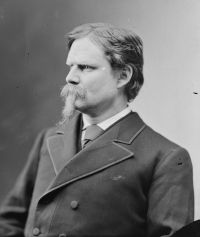 Henry Watterson,
Marse Henry: An Autobiography…
Henry Watterson,
Marse Henry: An Autobiography…
“ My enthusiasm over the Cass and Butler campaign had not subsided. Inevitably General Cass was to me the greatest of heroes. My father had been and always remained his close friend. Later along we dwelt together at Willard's Hotel, my mother a chaperon for Miss Belle Cass, afterward Madame Von Limbourg, and I came into familiar intercourse with the family.The general made me something of a pet and never ceased to be a hero to me. ”
 Bret Harte,
Found at Blazing Star
Bret Harte,
Found at Blazing Star
“ Cass felt an uncomfortable sense of incongruity in himself, in his story, in his treasure, to this temple of disenchanting realism. With the awkwardness of an embarrassed man he was holding prominently in his hand an envelope containing the ring and advertisement as a voucher for his intrusion, when the nearest clerk took the envelope from his hand, opened it, took out the ring, returned it, said briskly, "T'other shop, next door, young man," and turned to another customer. ”