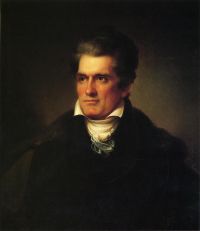
John C. Calhoun

Definition and stakes

Warsaw Message — July 12, 1843 Extra

If we cannot have a Southern States Rights man--if John C. Calhoun, by going upon the forlorn hope of truth, is (politically) dead upon the ramparts--like a gallant steed fallen in the front ranks--borne down and trampled upon by the rear, and can only look for justice from those who look upon these disjoined times, with an eye of posterity--if for disinterestedness above, and political sagacity beyond, the age he is to be sacrificed a martyr to principle--at least call upon us to support a man worthy of enthusiastic trust.
Source: Wikisource

Library of the World's Best Literature…

John C. Calhoun's importance as a statesman has naturally stood in the way of his recognition as a writer, and in like manner his reputation as an orator has overshadowed his just claims to be considered our most original political thinker. The six volumes of his collected works, which unfortunately do not embrace his still inaccessible private correspondence, are certainly not exhilarating or attractive reading; but they are unique in the literature of America, if not of the world, as models of passionless logical analysis.
Source: Gutenberg

Harry A. Lewis Hidden Treasures; Or, Why Some Succeed While Others Fail

Webster's funeral oration delivered in the Senate upon the announcement of his death is a most eloquent yet unexaggerated account of the virtues of John C. Calhoun.
"Calhoun was a part of his own intellectual character, which grew out of the qualities of his mind. It was plain, strong, wise, condensed, concise, still always severe. Rejecting ornament, not often seeking illustration; his power consisted in the plainness of his propositions, the clearness of his logic, and the earnestness and energy of his manner. No man was more respectful to others; no man carried himself with greater decorum
Source: Gutenberg

Get perspective with Kwize: daily news enlightened by great literature