“ But we turn our backs upon the dreary prospect, and send our thoughts onward towards the City of Rome whither we are fast journeying—not that ancient{2} city which sits upon its seven hills, like a discrowned queen, still ruling the world of Art, swaying the minds of men, and, like a gigantic loadstone, drawing the heart of the world towards herself, grander in her age of ruin than her youthful pride; the glory of her dead days circles her with a halo of poetry and romance which renders her immortal. ”
City of Rome
Definition and stakes
Quotes about “City of Rome”
Fredrika Bremer,
Life in the Old World
(1860)
“ It is a brilliant spectacle! But beyond this, is something greater and more brilliant still, the spectacle of Rome itself with its hundreds of churches, cupolas, obelisks, from the Vatican to the Capitol, and beyond the city the country; and beyond that, the western horizon, where the sun sets in Italian pomp of coloring, illumining still with its latest beams the pinacles of the eternal city, and the laurel groves of Monte Pincio. ”
“ V. ROME—THE THERMAE OF TITUS There were even birds, to fill the air with music. All the known world, and the far-away mysterious lands of which Alexander's followers had started legends multiplying centuries ago, had contributed to Rome's adornment; plunder and trade goods drifted through in spite of distances. The city had become the vortex of the energy, virility and vice of east and west—a glory of marble and gilded cornices, of domes and spires, of costumes, habits, faces, languages—of gorgeousness and squalor—license, privilege and rigid formalism—extravagance—and of innumerable gods. ”
“ Rome has been called the ‘Sacred City’—might not our Oxford be called so too? There is an air about it, resonant of joy and hope: it speaks with a thousand tongues to the heart: it weaves its mighty shadow over the imagination: it stands in lowly sublimity, on the ‘hill of ages,’ and points with prophetic fingers to the sky: it greets the eager gaze from afar, ‘with glistening spires and pinnacles adorned,’ that shine with an eternal light as with the lustre of setting suns ”
Émile Zola,
The Three Cities Trilogy: Rome…
“ Then, when the sun shall have absorbed all the pestilence of the old soil, we will rebuild the city ten times more beautiful and ten times larger than it has ever been. And what a city of truth and justice it will at last be, the Rome that has been announced and awaited for three thousand years, all in gold and all in marble, filling the Campagna from the sea to the Sabine and the Alban mountains, and so prosperous and so sensible that its twenty millions of inhabitants after regulating the law of labour will live with the unique joy of being. ”
“ But it is not towards this ancient city we are fast hastening; our City of Rome is the creation of to-day, it has nothing to say to the yesterdays; its kingdom belongs to the to-morrows, which are crowded into the years to come. ”
Vernon Lee,
The Spirit of Rome
“ For Rome is not an Urban City; and underneath all the Bernini palaces, we must imagine things like Palazzo Capranica, with the few mullioned and Gothic windows picked in its fortress-like walls. How I seem to feel what Rome is made of—its strange living components in the past!At Subiaco the streets were strewn, as for a procession, with shredded petals of violets. All kinds of violets grow on those hills, some reddish and as big as pansies; and as we swished past, instead of the dry scent of myrrh and mint of our Tuscan hills, there came a moist smell of violets from the hedgerows. ”
Scott Nearing,
Civilization and Beyond: Learning from History
(1975)
“ Establishing the city of Rome as a stable, defensible center of merchandising and commerce, transport, finance, population, wealth and power with a hinterland of associates and dependencies. As it turns out, the city of Rome has outlived both the Roman Empire and Roman Civilization. ”
Various, The Atlantic Monthly, Volume 09…
“ So silent, so lonely, so fair is this waving expanse with its guardian mountains, it might be some wild solitude, an American prairie or Asiatic steppe, but that in the midst thereof, on some billows of rolling land, we discern a city, sombre, quaint, and old,—a city of dreams and mysteries,—a city of the living and the dead. And this is Rome,—weird, wonderful, ancient, mighty Rome,—mighty once by physical force and grandeur, mightier now in physical decadence and weakness by the spell of a potent moral enchantment. ”
Michael Muller, Public School Education
“ One thousand eight hundred and forty-odd years ago, you might have observed a poor, meanly-clad wanderer, wending his steps on the Appian way to the Capitol of the world,—the wealthy, magnificent, and ungodly city of Rome. He has passed its gates, and threads his way unobserved through its populous streets. On every side he beholds gorgeous palaces raised at the expense of downtrodden nationalities; stately temples dedicated to as many false gods as nations were congregated in Rome ”
Margaret Fuller,
At Home and Abroad; Or, Things and Thoughts in America and Europe
“ One loses sight of all dabbling and pretension when seated at the feet of dead Rome,—Rome so grand and beautiful upon her bier. Art is dead here; the few sparkles that sometimes break through the embers cannot make a flame; but the relics of the past are great enough, over-great; we should do nothing but sit, and weep, and worship.In Rome, one has all the free feeling of the country; the city is so interwoven with vineyards and gardens, such delightful walks in the villas, such ceaseless music of the fountains, and from every high point the Campagna and Tiber seem so near. ”
Percy Bysshe Shelley,
The Prose Works of Percy Bysshe Shelley…
(1897)
“ Rome is yet the capital of the world. It is a city of palaces and temples, more glorious than those which any other city contains, and of ruins more glorious than they. Seen from any of the eminences that surround it, it exhibits domes beyond domes, and palaces, and colonnades interminably, even to the horizon; interspersed with patches of desert, and mighty ruins which stand girt by their own desolation, in the midst of the fanes of living religions and the habitations of living men, in sublime loneliness. ”
Samuel Langhorne Clemens, Sketches by Mark Twain (1879)
“ Our usually quiet city of Rome was thrown into a state of wild excitement yesterday by the occurrence of one of those bloody affrays which sicken the heart and fill the soul with fear, while they inspire all thinking men with forebodings for the future of a city where human life is held so cheaply, and the gravest laws are so openly set at defiance. ”
Edward Lucas White, Andivius Hedulio: Adventures of a Roman Nobleman in the Days of the Empire
“ To halt on that crest of the road, of a fair, still, mild, brilliant afternoon when the sun is already visibly declining and its rays fall slanting and mellow; to view the great city bathed in the warm, even light, its pinnacles, tower-roofs, domes, and roof-tiles flashing and sparkling in the late sunshine, all of it radiant with the magical glow of an Italian afternoon, to see Rome so vast, so grandiose, so majestic, so winsome, so lovely; to know that one owns one's share in Rome, that one is part of Rome; that, I conceive, confers the keenest joy of which the human heart is capable. ”
Wilkie Collins,
Antonina; Or, The Fall of Rome
“ Amid the solemn mournfulness that reigns over declining Rome, this delightful elevation rises light, airy, and inviting, at once a refreshment to the body and a solace to the spirit. From its smooth summit the city is seen in its utmost majesty, and the surrounding country in its brightest aspect. The crimes and miseries of Rome seem deterred from approaching its favoured soil; it impresses the mind as a place set apart by common consent for the presence of the innocent and the joyful—as a scene that rest and recreation keep sacred from the intrusion of tumult and toil. ”
F. Marion Crawford, Ave Roma Immortalis, Vol. 1
“ Rome was a brown city in those days, when there was no marble and little stucco: a brown city teeming with men and women clothed mostly in grey and brown and black woollen cloaks, like those the hill shepherds wear today, caught up under one arm and thrown far over the shoulder in dark folds. ”
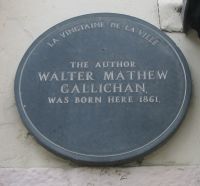
Walter M. Gallichan,
Old Continental Towns
“ The life of Rome is outdoor; folk loiter and congregate in the streets; there is much traffic of vehicles used for pleasure. Over the city stretches “the Italian sky,” ardently blue—the sky that we know from paintings before we have visited Rome—and upon the white buildings shines a hot sun from which we shrink in midsummer noons. ”
Mary Wollstonecraft Shelley, Rambles in Germany and Italy in 1840… (1844)
“ I scarcely know what view of Rome to prefer. That from the ruined Baths of Caracalla, or from the verge of the Coliseum, or the panorama of the Capitol, or from the porch of the Lateran, which commands a different landscape.—You see nothing of the city, for your back is turned on it; you are on a height, the Campagna at your feet, spanned by a number of ruined aqueducts, whose grandeur and extent impress the mind, more than any other object, with a sense of Roman greatness. ”
Émile Zola,
The Three Cities Trilogy: Rome…
“ There are squares, broad footways; lofty white carved buildings yet in the rough, littered with rubbish and fenced off. On every side you find as it were a huge building yard, which the financial crisis perpetuates; the city of to-morrow arrested in its growth, stranded there in its monstrous, precocious, surprising infancy. Nevertheless, therein lies good and healthful work, such as was and is absolutely necessary if Rome is to become a great modern city, instead of being left to rot, to dwindle into a mere ancient curiosity, a museum show-piece. ”
Guglielmo Ferrero,
Characters and events of Roman History
(1909)
“ Rome created the word that denotes this marvellous and monstrous phenomenon, of history, the enormous city, the deceitful source of life and death--urbs--the city. Whence it is not strange that the countless urbes which the grand economic progress of the nineteenth century has caused to rise in every part of Europe and America look to Rome as their eldest sister and their dean. ”
Frank Frost Abbott, The Common People of Ancient Rome
“ All these gifts were for the city of Rome, and for the people of the city, not for the Empire, nor for Italy. This is characteristic of ancient generosity or philanthropy, that its recipients are commonly the people of a single town, usually the donor's native town. It is one of many indications of the fact that the Roman thought of his city as the state, and even under the Empire he rarely extended the scope of his benefactions beyond the walls of a particular town. The small cities and villages throughout the West reproduced the capital in miniature. Each was a little world in itself. ”
Maturin M. Ballou,
Foot-prints of Travel; Or, Journeyings in Many Lands
“ A day's journey by railway takes us to Rome, the "Eternal City," which is built on both sides of the Tiber, three or four leagues from its influx to the Mediterranean. We know that this city must at one time have been nearly as populous as London is to-day, but the present number cannot much exceed four hundred thousand. The ruins of Rome—for it is a city of ruins, notwithstanding its many fine modern structures—can give but a faint idea of what the great capital was in the days of its glory. ”
S. Russell Forbes, Rambles in Rome
“ The contemplation of the city, however, produces the effect of a vast and solid reading of history. Each of the great representations of the city, always and differently mistress of the world, seems to have chosen its respective quarter—the Rome of the kings and emperors is spread out on the Palatine, Esquiline, and Quirinal; republican Rome occupies the Capitol and Aventine; whilst Christian Rome, isolated and solitary, reigns on the Cœlian and Vatican eminences. ”
Émile Zola,
The Three Cities Trilogy: Rome…
“ Under the glowing sky Rome stretched out in its immensity, empurpled and gilded by the slanting sunrays. Across the horizon, far, far away, the trees of the Janiculum stretched a green girdle, of a limpid emerald hue, whilst the dome of St. Peter's, more to the left, showed palely blue, like a sapphire bedimmed by too bright a light. Then came the low town, the old ruddy city, baked as it were by centuries of burning summers, soft to the eye and beautiful with the deep life of the past, an unbounded chaos of roofs, gables, towers, /campanili/, and cupolas. ”
Various, Robert Merry's museum, Volumes III-IV… (1842)
“ I had no choice; so, depositing my trunk in this same den of the bears till better quarters could be found, I set off for a ramble through the city.To a traveller who enters Rome as I did, at the waste end of the city, where he sees nothing but mouldering walls and heaps of grass-grown ruins, it is quite a matter of wonder to find, at the other extremity, such a collection of populous streets and splendid structures. My first steps were directed to St. Peter’s church, that ornament and wonder of modern Rome, the most magnificent edifice that the world ever saw. ”
Augustus J. C. Hare,
Walks in Rome
“ To our classic associations, Rome was still, under Trajan and the Antonines, the city of the Cæsars, the metropolis of pagan idolatry—in the pages of her poets and historians we still linger among the triumphs of the Capitol, the shows of the Coliseum; or if we read of a Christian being dragged before the tribunal, or exposed to the beasts, we think of him as one of a scattered community, few in number, spiritless in action, and politically insignificant. ”
Benito Mussolini,
My autobiography
“ It is not a thing of small moment [295] that all public utilities are conducted with an efficiency which I might call American, and that the Italian bureaucracy, proverbially slow, has become eager and agile.I have given particular attention to the Capital. Rome is a universal city, dear to the heart of Italians and of the whole world. It was great in the time of the Roman Empire and has conserved a universal light. It was the historical seat and the centre of diffusion of Christianity. Rome is first of all a city with the aura of destiny and history. It is the Capital of the New Italy. ”
Wilkie Collins,
Antonina; Or, The Fall of Rome
“ The clear and brilliant moonlight of Italy now pervades every district of the glorious city, and bathes in its pure effulgence the groves and palaces on the Pincian Mount. From the garden of Numerian the irregular buildings of the great suburbs of Rome, the rich undulating country beyond, and the long ranges of mountains in the distance, are now all visible in the soft and luxurious light. Near the spot which commands this view, not a living creature is to be seen on a first examination ”
Maurice Baring,
Dead letters
(1910)
“ In Rome there is a continuity with which nothing can interfere.” And he added that he thought there was something in the atmosphere, the vegetation, the very grass and the weeds of the place which acted like a spell and softened what was ugly and modern, reconciled all differences, and reduced all discords into an eternal harmony which was the genius of the city. ”
W. Cope Devereux, Fair Italy, the Riviera and Monte Carlo
“ It is pleasant to turn to the long-deserted Eastern quarter of Rome, where an entirely new city is being erected since the Italian occupation. We may yet hope to see Rome worthy of her past greatness. ”
Douglas Brooke Wheelton Sladen,
Twenty Years of My Life
“ About Rome I intend to publish a book like How to See Italy, and Sicily, the New Winter Resort, combined, to make use of my street by street study of the Eternal City. I know Rome far better than London. Rome has always appealed to my historical enthusiasm, in the one point where Florence leaves me cold, for Florence was, as it were, at the back of the door while kingdoms were being carved out of the unformed mass of Europe during the Middle Ages, while Rome gave the world laws, language and civilisation, collated from the wisdom of the ancient world. ”
Hugh Macmillan,
Roman Mosaics; Or, Studies in Rome and Its Neighbourhood
“ There is no city in the world more favourably situated for this purpose than Rome. Some of the most charming excursions may be made from it as a centre, starting in the morning and returning at night. Every tourist who stays but a fortnight in the city makes a point of seeing the idyllic waterfalls of Tivoli, the extensive ruins of Hadrian's Villa, the picturesque olive-clad slopes of Frascati and Tusculum, and the lovely environs of Albano on the edge of its richly-wooded lake. ”